
Veronica schmidtiana
Veronica schmidtiana
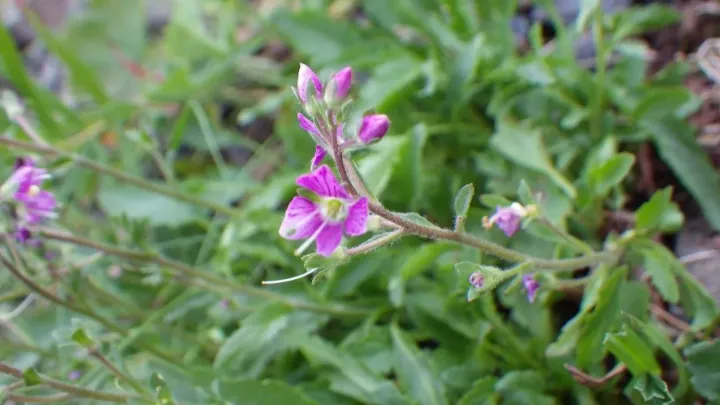
Description
How to tell it apart
Veronica schmidtiana is a perennial herbaceous plant belonging to the Plantaginaceae family. It is recognized by its compact growth habit, often forming dense mats or tufts with ascending stems densely covered in glandular hairs.
The leaves are typically opposite and display a distinctive pinnately lobed or deeply serrated structure, which serves as a key diagnostic feature for field identification. The inflorescence consists of terminal racemes with attractive violet-blue flowers.
It possesses a vigorous root system that allows for deep soil penetration and resilient growth. The plant propagates effectively both through seeds and vegetatively via rhizome fragments, making it persistent in cultivated fields.
This species exhibits significant ecological flexibility, thriving in various environments. In intensive farming, it acts as an aggressive weed that colonizes available space rapidly, outcompeting local vegetation.
The growth cycle initiates early in the season, giving Veronica schmidtiana a competitive edge over spring crops in terms of nutrient uptake and space utilization right from the germination stage.
Where it grows
This weed is most commonly found in well-drained soils, including sandy, stony, and gravelly substrates. It shows a strong preference for open, sun-exposed areas where competition is minimal.
In agricultural systems, Veronica schmidtiana often infests perennial grass fields, pastures, and meadows. It may also occur in cereal crops if the primary soil tillage and weeding practices are insufficient.
It frequently colonizes non-cultivated areas like road verges and fence lines, which act as reservoirs for seeds. Wind dispersal and agricultural equipment facilitate its spread into prime farmland.
Disturbed or eroded soils, as well as overgrazed lands, are highly susceptible to initial colonization. Once established, its perennial nature makes it a permanent fixture in the local flora.
In mountainous regions or cooler climates, the plant shows remarkable frost resistance, allowing its root systems to survive harsh winters and regenerate effectively the following spring.
Harm it causes
The primary damage caused by Veronica schmidtiana is intense competition for water and essential mineral nutrients. Its extensive root system depletes soil moisture rapidly, negatively impacting the crop yield.
In perennial grass stands, the presence of this weed reduces the overall quality of hay. It alters the nutritional composition of forage and may decrease palatability for livestock, lowering the value of the harvest.
The plant acts as an alternative host for various pathogens and pests that threaten major crops. This presence complicates phytosanitary management and increases the reliance on additional crop protection products.
Mechanical harvesting becomes difficult when the weed density is high, as the vegetative parts can clog machinery, leading to operational delays and increased fuel consumption during field work.
It interferes with crop stand uniformity, causing thinning of the desired plant population. This creates gaps in the field, which are subsequently filled by other invasive weeds, further degrading the field condition.
How to control
Mechanical control strategies focus on deep autumn plowing to bring rhizomes to the surface, where they can desiccate or be damaged by frost. Regular cultivation throughout the season helps suppress regrowth.
Crop rotation is an essential management tool. By varying crop types and planting times, farmers can interrupt the survival cycle of Veronica schmidtiana and reduce its population density over time.
Chemical control involves the use of systemic herbicides. These are applied either as spot treatments on non-crop areas or as selective herbicides in cereal crops to target broad-leaved weeds effectively.
Ensuring the purity of seeds is crucial to prevent the introduction of this weed into new areas. Using certified seed stocks is a fundamental step in integrated weed management programs.
- Shallow harrowing to provoke germination of the seed bank.
- Mowing margins before seed set to limit dispersal.
- Targeted herbicide application in high-density patches.
Taxonomy
- Latin name
- Veronica schmidtiana
- Family
- Подорожник большой
- EPPO code
- VERSH