
Littorella uniflora
Littorella uniflora
Description
How to tell it apart
Littorella uniflora, commonly known as shoreweed, belongs to the Plantaginaceae family. It is a small, perennial herbaceous plant characterized by a rosette of fleshy, linear leaves that grow from a central base, often resembling a tuft of grass.
The plant reproduces primarily via runners or stolons, allowing it to spread horizontally across the substrate. This vegetative growth leads to the formation of dense carpets on the bottom of shallow water bodies, which is a key identifying feature.
Littorella uniflora is an isoetid, meaning it has a specific adaptation for photosynthesis by absorbing carbon dioxide directly from the sediment through its roots, rather than solely relying on atmospheric gas exchange.
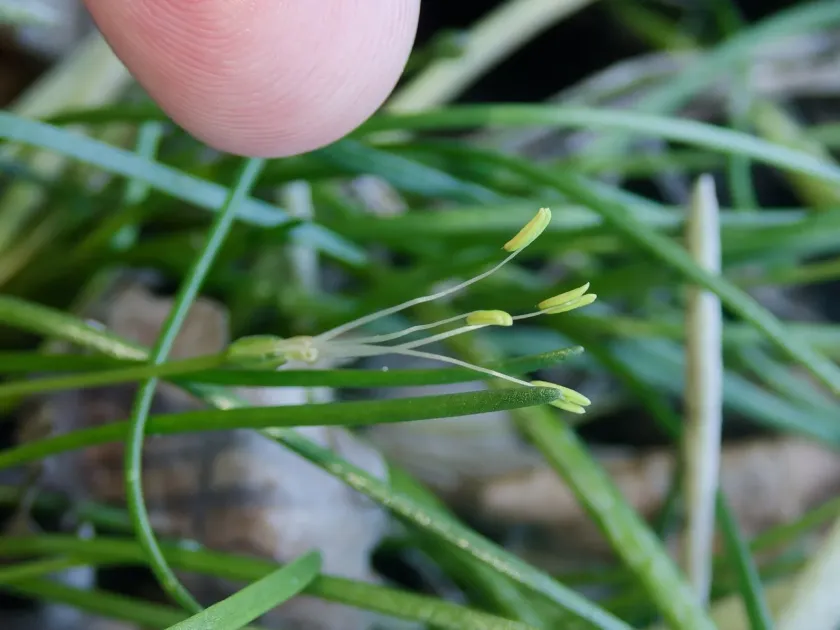
The flowers are unisexual: the male (staminate) flowers are usually found on slender stalks, while the female (pistillate) flowers are sessile. This morphological split makes them hard to identify outside of the mid-summer flowering season.
Its root system is fibrous and relatively shallow, enabling it to colonize both nutrient-poor sandy bottoms and more stable silty substrates in clear water environments.
Where it grows
Littorella uniflora is typically found in oligotrophic to dystrophic lakes, rivers, and ponds. It prefers clear, shallow water where sunlight can easily penetrate to the bottom, usually at depths of less than one meter.
It is often observed in the littoral zone of temperate region water bodies, particularly those with acidic or low-nutrient substrates where it faces less competition from larger, more aggressive aquatic weeds.
In agricultural settings, this species can become a nuisance in irrigation canals and managed reservoirs, where it occupies the bottom and slows down water flow. It thrives in areas where water levels are periodically adjusted.
The plant is highly adaptable to changing water levels; it can survive as an emergent plant on damp shores during low water periods and as a submerged plant when water levels rise again.
Global distribution includes northern and temperate latitudes. It is often regarded as an indicator of clean water quality, as it tends to disappear when eutrophication or high water turbidity occurs.
Harm it causes
The primary harm caused by Littorella uniflora in agricultural water infrastructure is the reduction of water flow capacity. By forming dense mats, it increases the roughness of the channel bottom, leading to sedimentation and slower water transit times.
In irrigation systems, this weed can cause significant operational issues by trapping suspended particles, leading to rapid siltation that necessitates frequent and costly mechanical dredging operations.
When present in paddy fields or aquatic crop cultivation, Littorella uniflora acts as a weed that competes with crops for nutrients and sunlight, potentially reducing overall yield during the early development stages of the plants.
The plant's dense growth can also obstruct pump intakes and filtration systems, leading to increased maintenance costs and potential mechanical failure of irrigation infrastructure.
Furthermore, large-scale accumulation of organic biomass in managed water bodies can influence the chemical balance of the water, potentially leading to oxygen depletion when the plant matter decomposes.
How to control
Mechanical removal is the most common control method. Specialized aquatic weed cutters and rakes are used to clear the biomass and the stolon network from the bottom of irrigation channels to restore proper flow rates.
Water level manipulation serves as an effective agronomic tool. By draining channels or lowering water levels for a period, the plant becomes susceptible to desiccation, which is highly effective since it requires consistent moisture to thrive.
Chemical control is strictly limited due to environmental regulations protecting aquatic ecosystems. Herbicides are generally only permissible if the area has been completely drained and left dry for a significant period.
Prevention involves regular desilting of channels. By maintaining a clean, firm substrate, the conditions become less favorable for the colonization and spreading of the plant's stolons.
Enhancing water flow velocity is a natural management strategy, as Littorella uniflora prefers slow-moving or stagnant water; increasing the current can prevent the formation of dense, stable mats of the weed.
Taxonomy
- Latin name
- Littorella uniflora
- Family
- Подорожник большой
- EPPO code
- LTLUN