
Veronica peregrina
Veronica peregrina
Description
How to tell it apart
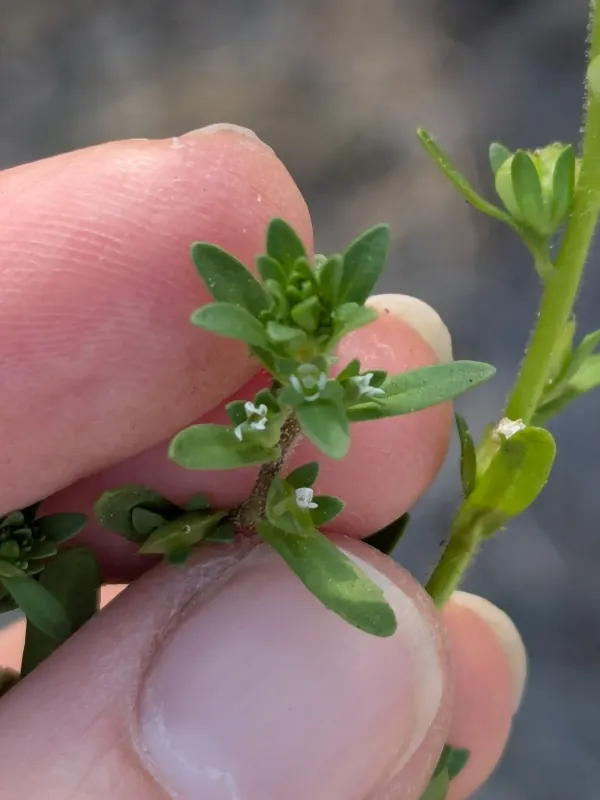
Veronica peregrina, commonly known as neckweed or purslane speedwell, is an annual herbaceous plant belonging to the Plantaginaceae family. It typically features a branched stem that grows to a height of 10 to 30 cm.
The leaves are lanceolate or linear-lanceolate, either entire or sparsely toothed, and arranged oppositely at the base and alternately near the top. The surface of the leaves is glabrous (smooth), which is a key identifying feature.
The flowers are small, sessile, and located in the axils of bract-like leaves, forming loose racemes. The petals are generally white or pale blue and shorter than the sepals, making the plant easily overlooked during early growth stages.
The fruit is an obcordate, flattened capsule that splits open upon maturity. It produces numerous small, yellowish-brown seeds, contributing to the plant's high reproductive potential.
The root system is a taproot, which is relatively weak, allowing it to easily anchor in moist soils and colonize space within various crop rows quickly.
Where it grows
This species favors moist environments. In agricultural settings, Veronica peregrina is most frequently found in fields with poor drainage, along stream banks, in ditches, and in low-lying areas of the terrain.
The weed actively infests grain fields, row crops, gardens, and nurseries. It is capable of surviving temporary flooding, which provides it a competitive advantage over many other weed species.
Seed dispersal occurs primarily through water runoff, as well as via soil attached to agricultural machinery and tillage equipment. The plant exhibits high ecological plasticity.
Veronica peregrina often emerges in compacted soils where water pools after rainfall. This makes it a reliable indicator of waterlogged conditions in specific parts of a field.
Under intensive farming conditions, this weed can rapidly occupy fallow fields and crops requiring frequent irrigation, becoming a significant obstacle to crop productivity.
Harm it causes
The primary damage caused by Veronica peregrina lies in its intense competition for water and soil nutrients. Due to its rapid life cycle, it can suppress the development of crop seedlings during early growth stages.
Dense mats of this weed create shading, which negatively affects the photosynthesis and overall vigor of cultivated plants. This leads to reduced yields and inferior product quality at harvest.
Its presence in fields complicates standard agronomic operations and increases costs associated with cleaning contaminated seed harvests. High seed production ensures a persistent soil seed bank.
Veronica can act as a reservoir for various plant pathogens and pests, which may subsequently migrate to the main crop, further complicating the phytosanitary situation in the field.
In intensive irrigation systems, the weed can spread as a solid carpet, completely outcompeting crops in areas where soil drainage is inadequate.
How to control
Agronomic measures include proper soil preparation aimed at eliminating weed seedlings before planting the primary crop. Managing soil compaction and ensuring effective drainage are critical components of long-term control.
Systematic weeding and inter-row cultivation in row crops significantly reduce the population of Veronica peregrina. Strict protocols for cleaning seed lots and farm machinery must be maintained.
Chemical control should be based on regular monitoring. Effective herbicides are typically applied when weeds are actively growing but before they reach the flowering and seed-setting stages.
Key control strategies include:
- Timely deep autumn plowing to bury surface seeds.
- Adhering to crop rotations that include competitive crops.
- Use of broad-spectrum herbicide tank mixes when necessary.
A vital element of control is managing the weed on non-cropped areas, field edges, and along farm roads to prevent the spread of seeds into the cultivated fields.
Taxonomy
- Latin name
- Veronica peregrina
- Family
- Подорожник большой
- EPPO code
- VERPG