
Description
Mode of action
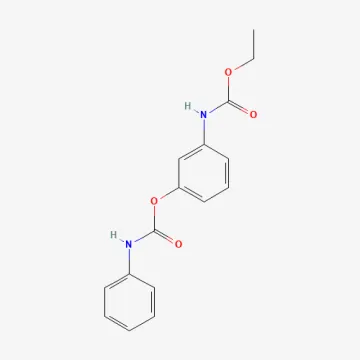
Desmedipham belongs to the chemical class of phenylcarbamates. It is a highly effective active ingredient acting as a selective herbicide, primarily used to inhibit photosynthesis in target weed species.
The mode of action involves the inhibition of electron transport in the photosystem II complex within the weed leaves. This interference disrupts the light-dependent reactions of photosynthesis, leading to the cessation of growth and eventual plant death.
The substance is absorbed through the foliage of weeds. Its selectivity is based on the ability of the crop plants, such as sugar beets, to metabolize the herbicide into non-toxic compounds, ensuring the safety of the treated crop.
Optimal efficacy is achieved when the herbicide is applied to weeds at their early development stages, specifically the cotyledon or two-leaf stage. Timely application is crucial for maximizing its performance.
Desmedipham is commonly formulated in combination with other herbicides like phenmedipham and ethofumesate. These mixtures are designed to broaden the spectrum of weed control and manage resistant weed populations effectively.
What it targets
Desmedipham is specifically intended for the control of a wide range of annual broad-leaved weeds that commonly infest sugar beet fields, causing competition for water and nutrients.
Key target species include lambsquarters, pigweed, knotweed, shepherd's purse, wild radish, and several other competitive broad-leaved plants that appear during the growing season.
It is important to note that desmedipham has little to no activity against grass weeds. Therefore, integrated weed management programs usually include separate grass-specific herbicides to provide comprehensive field protection.
The effectiveness of the product is highly dependent on the weed growth stage. Older, more mature weeds become significantly more tolerant, which underscores the necessity of early intervention.
Effective weed management with desmedipham helps to maintain an optimal growing environment for the crop, preventing the yield loss associated with early-season weed competition.
Rates and timing
Application rates are determined by the weed spectrum, weed density, and the growth stage of the crop. Split-application programs, where the total dose is divided into several smaller treatments, are widely practiced.
A typical approach involves three successive applications with intervals of 7 to 10 days, allowing the manager to target multiple germination flushes of weeds throughout the critical growth period.
Uniform spray coverage is essential for performance. Using high-quality nozzles that produce the correct droplet size ensures that the active ingredient is well-distributed over the leaf surface of the weeds.
Favorable temperatures for application range from 15 to 25 degrees Celsius. Extreme temperatures, whether very cold or excessively hot, may reduce the biological activity of the herbicide.
Avoid applying the herbicide if the crops are under environmental stress, such as drought, frost, or pest damage, as this may increase the risk of temporary phytotoxicity to the beet plants.
Restrictions
Desmedipham should be handled with standard care, strictly adhering to safety guidelines and utilizing personal protective equipment (PPE) such as gloves, goggles, and protective clothing during handling and application.
Prevent spray drift into non-target areas, sensitive crops, or nearby water bodies. Monitoring wind conditions during application is essential for environmental stewardship and regulatory compliance.
The substance does not show significant soil persistence, which is an advantage for crop rotation. It breaks down into natural degradation products relatively quickly after contact with the environment.
Store the product in its original, sealed containers within a cool, dry, and secure location, ensuring it is kept away from unauthorized persons and children.
Always perform a compatibility test when mixing desmedipham with other pesticides or fertilizers to ensure that the chemical stability and physical properties of the mixture are maintained.
Content graph
Connections · Desmedipham
Most often together:
Marketplace
Products · 142


Biceps Guarant
ЗАТ Фірма Август, Росія.,селище Вурнари,
Herbicides
0
0
·
2.4K
11 offers
0.65 €per 1 l
Buy




Belveder Forte
Finkemü Schwebda, F.GmbH, GERMANY, MEMBER OF GROUP
Herbicides
0
0
·
959
12 offers
15.9 €per 1 l
Buy


TriO Lux
Ф.Суперус Ко ., Лтд., Гонг-Конг, Шанхай, Китай.
Herbicides
0
0
·
920
3 offers
15.07 €per 1 l
Buy

Belveder
Finkemü Schwebda, F.GmbH, GERMANY, MEMBER OF GROUP
Herbicides
0
0
·
871
1 offer
20.41 €per 1 l
Buy


Gorinich
«Нанджин Ессенс Файн-Кемікал Ко. Лтд» (Китай)
Herbicides
0
0
·
663
3 offers
34.4 €per 1 l
Buy


COMRADE K.E.
Аріста ЛайфСайенс С.А.С., Ногер, Франція
Herbicides
0
0
·
80
1 offer
21.97 €per 1 l
Buy


Alfa-Brigadir
Jiangsu Good Harvest-Wayen Agrochemical Co., Ltd.
Herbicides
0
0
·
65
4 offers
9.47 €per 1 l
Buy


Vitalon Expert
«Нанджин Ессенс Файн-Кемікал Ко. Лтд» (Китай)
Herbicides
0
0
·
63
4 offers
13.13 €per 1 l
Buy


Mitchell, KE
China Chemical Industrial & Rice Co. Ltd
Herbicides
0
0
·
61
4 offers
34.4 €per 1 l
Buy

Expert Trio c.e.
«Нанджин Ессенс Файн-Кемікал Ко. Лтд» (Китай)
Herbicides
0
0
·
59
1 offer
12.87 €per pack
Buy


Alfa-Brigadir
Jiangsu Good Harvest-Wayen Agrochemical Co., Ltd.
Herbicides
0
0
·
55
6 offers
9.27 €per 1 l
Buy
Triolux
Ф.Суперус Ко ., Лтд., Гонг-Конг, Шанхай, Китай.
Herbicides
0
0
·
55
1 offer
1.51 €per 1 l
Buy


Alpha-Brigadier c.e.
«Юнісіті Ентерпрайсіс Л.П.», Единбург, Великобританія
Herbicides
0
0
·
54
2 offers
9.44 €per 1 l
Buy


BITTER EXTRA
Лабораторіос Алкотан С.А., Севілья, Іспанія
Herbicides
0
0
·
52
2 offers
7.37 €per 1 l
Buy

Belvedere Forte c.s.
Agan Chemical Manufacturers Ltd., f.
Herbicides
0
0
·
52
1 offer
20.41 €per 1 l
Buy

Mitchell c.e.
China Chemical Industrial & Rice Co. Ltd
Herbicides
0
0
·
52
4 offers
34.4 €per 1 l
Buy

AMARANT
«Нанджин Ессенс Файн-Кемікал Ко. Лтд» (Китай)
Herbicides
0
0
·
52
1 offer
2 270.25 €per pack
Buy
