
Aepus robinii
Aepus robinii
Description
How to identify
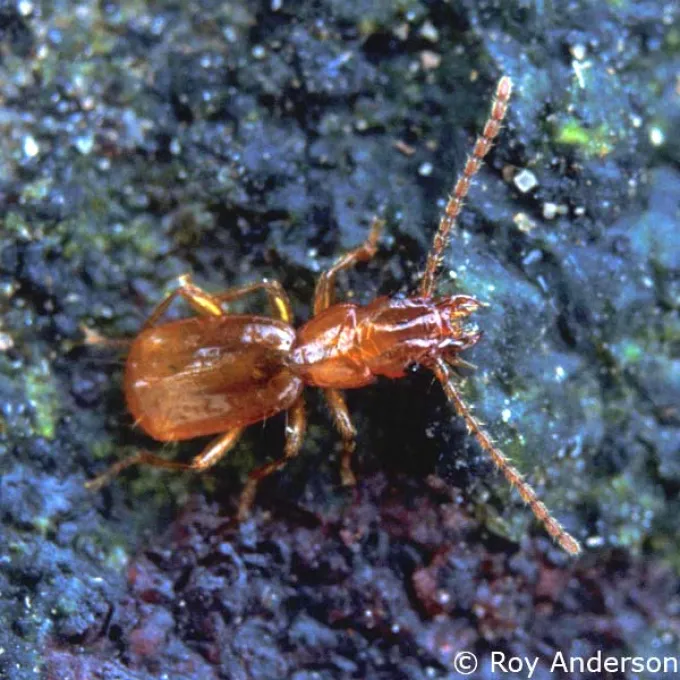
Aepus robinii is a small species of beetle belonging to the Carabidae family, commonly known as ground beetles, within the order Coleoptera. This species is specifically adapted to the harsh, shifting environment of the intertidal zone along sea coasts.
Their bodies are remarkably flattened, which serves as a physiological adaptation allowing them to inhabit narrow crevices between rocks and within porous coastal substrates without being crushed by tide-driven debris.
The coloration of these beetles is typically dark brown or reddish, providing excellent camouflage against wet sand, pebbles, and decaying seaweed, which are their primary habitats.
As a result of their subterranean and nocturnal lifestyle, their eyes are reduced, and they rely heavily on their tactile appendages and antennae to navigate and locate organic matter for food.
They are classified as halophilic organisms, possessing specialized biological mechanisms that allow them to endure fluctuating salinity levels and periodic water immersion characteristic of their niche.
What it damages
Aepus robinii is not considered a significant agricultural pest in traditional farming systems. Their diet primarily consists of detritus, marine micro-organisms, and small invertebrates found in coastal ecosystems.
However, when greenhouses or plant nurseries are established directly on or near coastal dunes, these beetles may migrate into the artificial environment, attracted by moist, organic-rich potting soils.
While they do not possess specialized mouthparts for aggressive plant tissue consumption, their movement within the soil can potentially disturb the root systems of very young or tender seedlings.
The main concern regarding this species is often diagnostic confusion; farmers might mistake their presence for more harmful root-feeding pests, leading to unnecessary and potentially harmful chemical applications.
Overall, the economic damage caused by this species is negligible and generally localized to specific coastal agricultural setups where hygiene practices are suboptimal.
When it appears
The activity patterns of Aepus robinii are closely tied to the ambient temperature of the coastal environment, which is generally moderated by the proximity to the sea.
Peak metabolic activity and reproductive cycles typically occur during the warmer months, when temperatures are high enough to support the development of larvae and active foraging of adults.
During the cooler autumn and winter seasons, these beetles enter a period of reduced activity or diapause, retreating deeper into the soil profile to avoid freezing temperatures and exposure to extreme tidal conditions.
Their activity is also rhythmic, often aligning with tidal cycles; they are known to seek refuge deep within the substrate when the tide is high and emerge when the shore is exposed.
Understanding these activity cycles is crucial for effective monitoring, as survey efforts should be concentrated during the late spring and summer months when adults are most visible on the surface.
Signs of infestation
Detection of Aepus robinii is best achieved by inspecting the soil surface near decaying vegetation or moist litter in coastal areas where they are suspected to reside.
Evidence of their presence includes small, irregular tunnels in the topsoil and the discovery of individuals when turning over rocks or wet organic debris during low tide or damp morning conditions.
If seedlings are wilting, one should check for physical disturbance in the root zone; however, finding the beetle itself is the only definitive proof of presence, as other soil-dwelling insects may be the true culprits.
Using pitfall traps buried flush with the soil surface in moist coastal nursery beds can provide a reliable count of the beetle population present in the area.
A persistent damp or rotting smell in the soil often indicates conditions favorable to these beetles, suggesting that sanitation efforts are required to deter colonization.
Control measures
Effective management focuses on cultural practices rather than the use of chemical pesticides, as these beetles do not constitute a direct threat to most crops.
Improving sanitation by removing decaying organic matter and seaweed debris from the immediate vicinity of plant beds will significantly reduce the suitability of the habitat for these insects.
Maintaining proper soil moisture levels and ensuring well-draining substrates can make the environment less attractive to Aepus robinii, as they require high humidity to survive.
Physical barriers, such as mulching with coarse materials or using fabric ground covers, can prevent these beetles from accessing the sensitive root zones of young plants.
If intervention is strictly necessary, biological control agents such as entomopathogenic nematodes can be utilized, as they are highly effective against soil-dwelling insects while remaining environmentally friendly.
Taxonomy
- Latin name
- Aepus robinii
- Order
- Coleoptera (beetles)
- Family
- Carabidae
- EPPO code
- AEPURO
Discussion
No discussions yet — be the first.