
Abax parallelepipedus
Abax parallelepipedus
Description
How to identify
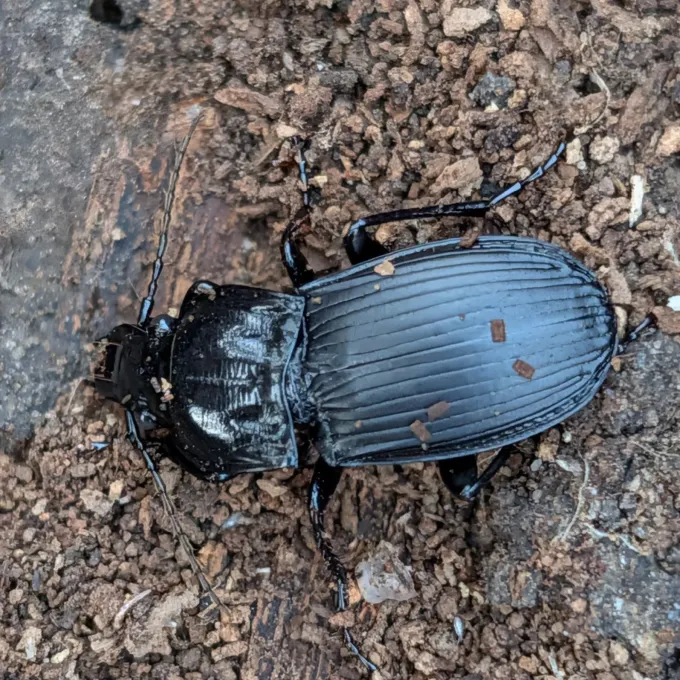
Abax parallelepipedus is a medium to large-sized ground beetle from the Carabidae family. The adult beetle reaches a length of 17 to 22 mm and has a distinct elongated body shape.
The coloration is typically deep black, sometimes showing a subtle metallic sheen. The wing covers are smooth with barely visible longitudinal grooves, providing a sleek appearance.
The head features powerful mandibles, which are essential for its predatory lifestyle. The antennae are of medium length, helping the beetle navigate through dense vegetation and soil debris.
Larvae are also predatory, featuring elongated bodies with well-developed thoracic legs. They spend their entire developmental period in the soil environment.
This beetle is strictly nocturnal. During the day, it seeks refuge under stones, logs, or thick leaf litter to avoid dehydration and predation.
What it damages
Abax parallelepipedus is not a plant pest. In fact, it is considered a beneficial predator that plays a significant role in biological pest control within agricultural areas.
Its diet consists primarily of slugs, snails, caterpillars, and larvae of other insects. By consuming these, the beetle helps reduce damage to crops caused by true pests.
Plant material consumption by this species is negligible and not a threat to healthy crops. It performs a vital ecological service by regulating insect populations.
Farmers are encouraged to view this beetle as an ally. Its presence in the field is a positive sign of healthy soil biodiversity and natural pest suppression.
No agricultural damage is attributed to this species, making control measures unnecessary and counterproductive to sustainable farming.
When it appears
Adult activity begins early in the spring as soon as soil temperatures increase sufficiently. They emerge from hibernation to forage for prey.
Breeding takes place during the spring and summer months. Females lay their eggs in damp soil pockets that provide optimal conditions for the larvae.
The larval stage is active throughout the summer, feeding on various small soil-dwelling invertebrates. Development is completed before the onset of autumn.
Overwintering occurs either as an adult or a pupa deep within the soil or in leaf litter, protecting the population from freezing temperatures.
Seasonal fluctuations are largely driven by humidity levels and the availability of food sources rather than temperature alone.
Control measures
Control measures against Abax parallelepipedus are not required as it is a beneficial organism. Instead, management practices should focus on conservation.
Preserving natural habitats, such as field margins, hedgerows, and reducing deep tillage, helps maintain healthy populations of this predatory beetle.
Minimizing the use of broad-spectrum insecticides is crucial for the survival of this and other beneficial ground beetles in farmland.
Encouraging this predator is a key component of Integrated Pest Management (IPM), reducing the need for synthetic chemical applications.
- Habitat preservation.
- Reduced soil disturbance.
- Integrated pest management.
Taxonomy
- Latin name
- Abax parallelepipedus
- Order
- Coleoptera (beetles)
- Family
- Carabidae
- EPPO code
- ABAXPE
Discussion
No discussions yet — be the first.