

Pest · Hemiptera (bugs, aphids, leafhoppers) · affects Winter wheat, Winter barley, Fodder beet
Especially harmful
Sunn pest
Eurygaster integriceps
Description
How to identify
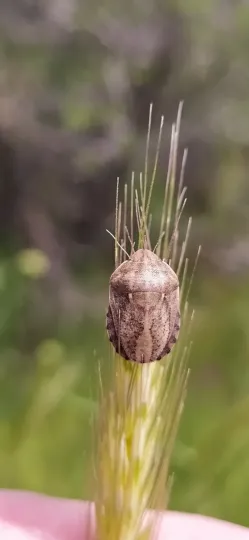
The Sunn pest (Eurygaster integriceps) belongs to the Scutelleridae family. Adults are shield-shaped, measuring 10–13 mm, with a color range from light gray to dark brown.
They possess a piercing-sucking mouthpart, which is used to feed on the sap of stems, leaves, and eventually the developing kernels of grain crops.
The insect develops through incomplete metamorphosis. Eggs are laid in clusters on the underside of leaves, and nymphs undergo five molting stages before reaching adulthood.
Overwintering occurs in forested areas, specifically under leaf litter or sheltered ground cover, where they remain dormant during cold months.
In spring, as temperatures rise, these insects migrate in mass to grain fields, initiating the infestation cycle for the current growing season.
What it damages
The primary hosts for the Sunn pest are cereal crops, including wheat, barley, and rye, with wheat being the most severely affected by their feeding habits.
While cereal grains are their main target, they may also infest other crops such as onion, fodder beet, rapeseed, cabbage, hemp, pepper, watermelon, and melon, particularly during migration.
On vegetable crops, they cause wilting and structural damage by piercing stems and leaves, which can stunt plant growth and reduce overall yield quality.
The most significant economic damage occurs when the pest feeds on developing kernels, injecting enzymes that degrade gluten and starch during the grain-filling stage.
Even a small percentage of infested grains can result in flour with poor baking quality, rendering the entire harvest potentially unfit for bread production.
When it appears
The insects emerge from overwintering sites in early spring, typically when daily temperatures consistently exceed 10–12°C, and migrate to wheat fields.
After initial feeding, they reproduce and lay eggs. The nymph stage, which is highly active on grain crops, typically occurs between May and June.
As the grain ripens, the new generation of adults matures and prepares for the summer-autumn migration back to forested habitats.
The entire life cycle is strictly synchronized with the phenology of cereal grains, ensuring the pest has access to nutrients at the most critical growth stages.
Following harvest, these insects abandon the fields to enter diapause, effectively hiding away until the cycle repeats in the following spring.
Signs of infestation
Early infestation signs include the wilting and yellowing of the central leaf in young wheat plants, often mistaken for nutrient deficiencies or fungal diseases.
Feeding on stems during the heading stage often causes "whiteheads," where the entire ear dies, turns white, and fails to develop any viable grain.
On the grain surface, feeding sites are identified by small, dark spots with a lighter ring, caused by the enzyme injection that occurs during the sucking process.
During peak infestation, the presence of various developmental stages of the insect on the stalks and ears is easily observable upon field inspection.
- Whiteheads in wheat crops during the grain-filling stage.
- Small necrotic spots on harvested grain kernels.
- Reduced crop vigor and stunting in early vegetative stages.
Control measures
Cultural control is essential, including early sowing and prompt harvesting to minimize the duration that crops are exposed to the pests during their most vulnerable stages.
Good agricultural practices like stubble cultivation and deep plowing immediately after harvest help destroy remaining pests and eliminate their survival sites.
Biological control methods involve the use of egg parasitoids like Trissolcus species, which can significantly reduce pest populations in natural ecosystems.
Chemical control remains the most common method, utilizing insecticides targeted against first and second-instar nymphs before they cause irreversible grain damage.
Strict monitoring and determining the economic threshold are crucial to ensure that insecticide applications are both effective and environmentally responsible.
In brief
33
Damages crops
Content graph
Damages crops · 33
Content graph
Connections · Sunn pest
Most often together:
Nutrient elements
1 contact
Marketplace
Products · 491
All 491
Insecticides, Acaricides 463
Plant Growth Regulators 7
Wheat 6
Herbicides, Desiccants 6
Fungicides 3
Barley 2
Rapeseed 1
Sugar Beet 1
Potato 1
Sunflower 1


Balaor Protect
Hangzhou Ruijiang Chemical Co., Ltd.
Insecticides
0
0
·
53
5 offers
2.49 €per 1 l
Buy


Lightning k.e.
Тейл Експортс ПВТ Лімітед, Ченнай, Індія
Insecticides
0
0
·
53
8 offers
0.12 €per pack
Buy

Fortran, k.e., (dichlorvos, 400 g/l)
Санрайз Кемікалз Ко. Лтд., Шанхай, Китай
Insecticides
0
0
·
53
1 offer
68.95 €per pack
Buy

Insecticide Anticolored, active substance (imidacloprid, 150 g/l)
Agrochemical Factory, LLC
Insecticides
0
0
·
53
10 offers
2.75 €per 1 l
Buy

Pilarmax EC, (dichlorvos, 400 g/l)
Піларквім (Шанхай) Ко., Лтд. (Pilarquim (Shanghai) Co, LTD), Шанхай, Китай
Insecticides
0
0
·
53
1 offer
152 €per 1 l
Buy
Super Bison
«Юнісіті Ентерпрайсіс Л.П.», Единбург, Великобританія
Insecticides
0
0
·
53
9 offers
5.93 €per 1 l
Buy

Zali, EC, Insecticide
Ф.Меатон Лімітед, Лондон, Великобританія.
Insecticides
0
0
·
53
3 offers
0.89 €per 1 l
Buy


AKM (Fertus)
ПП «ВКФ «Імпторгервіс», Україна
Plant Growth Regulators
0
0
·
52
2 offers
12.04 €per 1 l
Buy


Espada
ДВА Кемікалс Ко. Лтд., Китай (DVAChemicalsCo.Ltd.),China;
Insecticides
0
0
·
52
1 offer
37.52 €per 1 l
Buy


Altex 100 I.U.
China Chemical Industrial & Rice Co. Ltd
Insecticides
0
0
·
52
3 offers
4 €per 1 l
Buy

Zalp
«Юнісіті Ентерпрайсіс Л.П.», Единбург, Великобританія
Insecticides
0
0
·
52
3 offers
1.49 €per 1 l
Buy


Status, CS
«Нанджин Ессенс Файн-Кемікал Ко. Лтд» (Китай)
Insecticides
0
0
·
51
2 offers
45.48 €per 1 l
Buy


Insecticide preparation «Chlorpirifit-agro», a.e., (chlorpyrifos 50
«Нанджин Ессенс Файн-Кемікал Ко. Лтд» (Китай)
Insecticides
0
0
·
51
3 offers
7.75 €per 1 l
Buy


Canonir VG
«Джангсу Інстітут оф Екомоне Чангжоу, Китай.с»,
Insecticides
0
0
·
51
1 offer
95.8 €per 1 l
Buy


Rotalaz, active ingredient (alpha-cypermethrin, 100 g/l)
Rotam India Ltd.
Insecticides
0
0
·
50
2 offers
2.15 €per pack
Buy


SkoroBei-Zorya
LLC "SCIENTIFIC-PRODUCTION ENTERPRISE "UKRA"
Insecticides
0
0
·
50
1 offer
3.42 €per 1 l
Buy

Hunter
ТОВ «Фабрика агрохімікатів», Черкаси, Україна
Insecticides
0
0
·
50
2 offers
11.96 €per 1 l
Buy


VAMP 200 VP
Фадер Альянс Лтд., Великобританія (Fader Alliance Ltd., England) на заводах Нідерландів, Польщі
Insecticides
0
0
·
49
6 offers
16.08 €per 1 l
Buy


Douglas c.e.
China Chemical Industrial & Rice Co. Ltd
Insecticides
0
0
·
48
2 offers
1.06 €per 1 l
Buy


Taipro Protect
Hangzhou Ruijiang Chemical Co., Ltd.
Insecticides
0
0
·
48
2 offers
6.65 €per 1 l
Buy


Biology
Taxonomy
- Latin name
- Eurygaster integriceps
- Order
- Hemiptera (bugs, aphids, leafhoppers)
- Family
- Scutelleridae
- EPPO code
- EURYIN
Community
Discussion
No discussions yet — be the first.