
Hawaiian shield bug
Coleotichus blackburniae
Description
How to identify
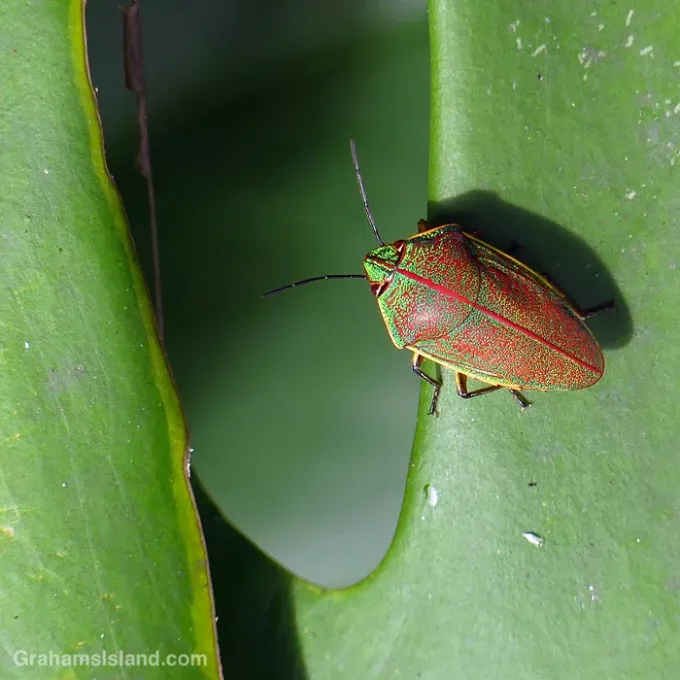
The Hawaiian shield bug Coleotichus blackburniae belongs to the order Hemiptera and the family Scutelleridae. Adults are recognized by their oval, convex, shield-like body shape and vibrant coloration.
The adult body length is typically between 12–15 mm. They possess a prominent scutellum that covers most of the abdomen, which is the defining physical characteristic of the Scutelleridae family.
Nymphs share a similar general appearance to adults but are distinguished by their smaller size and the absence of fully developed wings. Their coloration often evolves through different developmental stages.
As an endemic species of the Hawaiian Islands, their morphology has adapted to survive and thrive within the specific ecological niche of the local flora.
These insects are primarily diurnal, often clustering on the sunny sides of leaves and stems. Their cryptic coloration allows them to blend in with foliage when at rest.
What it damages
The Hawaiian shield bug is a sap-sucking pest that uses its specialized piercing-sucking mouthparts to extract vital fluids from plant tissues.
Their primary host plants include members of the Fabaceae family, particularly the Koa tree (Acacia koa), as well as certain species of Euphorbia.
The feeding damage is most significant on young shoots, flower buds, and developing fruits, leading to the overall weakening of the host plant.
Continuous feeding causes the development of necrotic spots at the puncture sites and inhibits the plant's ability to transport nutrients effectively.
Severe infestations can lead to premature leaf drop, stunted shoot growth, and a significant reduction in the plant's reproductive success.
When it appears
The lifecycle of Coleotichus blackburniae is closely tied to the phenology of its host plants. Activity levels increase significantly during warm and dry periods.
Reproduction can occur throughout the year in the mild Hawaiian climate, though population spikes often align with the active growth cycles of local trees.
Females typically deposit eggs in dense clusters on the undersides of leaves, providing natural shelter from the elements and predators.
The developmental period from egg to adult encompasses five nymphal instars, with the duration of each stage largely dependent on ambient temperature.
In cooler temperatures, the metabolism of the shield bug slows down, and individuals may seek refuge in bark crevices or among debris to survive the less favorable conditions.
Signs of infestation
The primary visual indicator of an infestation is the direct observation of adults or nymphs congregating on foliage and soft plant parts.
Localized chlorosis, appearing as small yellow or bleached spots, is a common sign of previous feeding activity on leaves and stems.
The presence of small, dark, and circular fecal droplets on the undersides of leaves is a tell-tale sign that a colony has been established.
- Yellowing and curling of leaf margins.
- Deformation of developing flower buds and seed pods.
- Premature fruit and leaf drop.
- Localized tissue necrosis at feeding sites.
Identifying the barrel-shaped eggs laid in orderly rows on leaves is a critical sign for early intervention before the population reaches damaging levels.
Control measures
Systemic insecticides are effective in managing shield bug populations, as they are absorbed into the plant and target the pests during their feeding process.
Cultural control methods involve the regular pruning of heavily infested branches and maintaining clean orchard or garden floors to reduce shelter sites.
Conservation of native natural enemies, such as parasitic wasps and predatory insects, plays a vital role in keeping populations below economic damage thresholds.
Monitoring using pheromone or sticky traps is recommended for early detection, allowing for targeted application of controls only when necessary.
For minor infestations, manual collection of bugs during early morning hours, when they are least mobile, can effectively suppress local populations without chemical use.
Taxonomy
- Latin name
- Coleotichus blackburniae
- Order
- Hemiptera (bugs, aphids, leafhoppers)
- Family
- Scutelleridae
- EPPO code
- COLTBL
Discussion
No discussions yet — be the first.