
Coleotichus sordidus
Coleotichus sordidus
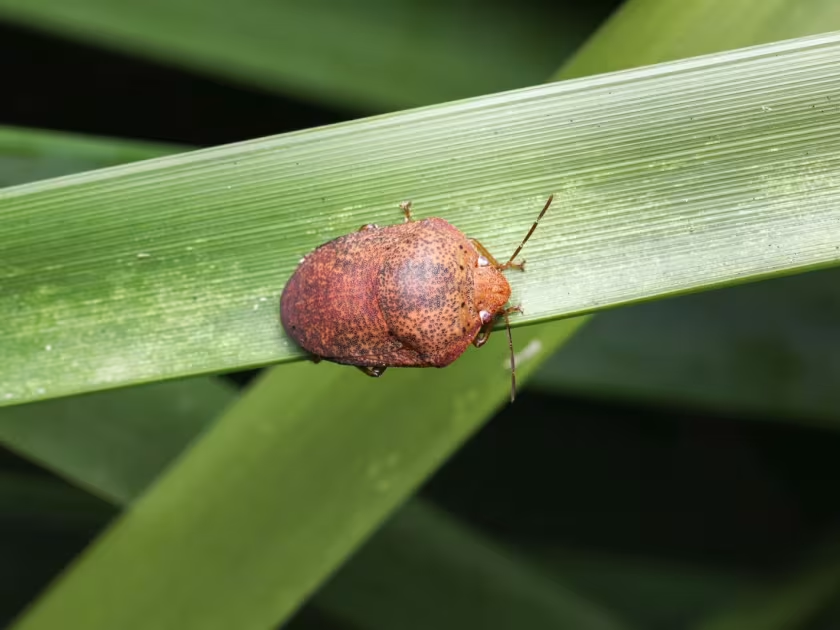
Description
How to identify
Coleotichus sordidus is a member of the Scutelleridae family (jewel bugs or metallic shield bugs) within the order Hemiptera. These insects typically have an oval-shaped body, reaching lengths of about 10–12 mm.
Their coloration is generally pale yellow to ochre, often marked with longitudinal dark stripes or spots on the pronotum and scutellum, providing excellent camouflage against dry stems.
The head features a specialized piercing-sucking proboscis, which is the primary tool used for feeding on plant fluids.
Eggs are commonly deposited in clusters on the underside of leaves or on stems, a reproductive strategy typical for many species in the Scutelleridae family.
Nymphs resemble the adult insects but are distinguished by their smaller size and the lack of fully developed wings, progressing through several instars before reaching maturity.
What it damages
The damage caused by this insect involves the extraction of sap from the aerial parts of plants, which severely disrupts the plant's physiological development.
These bugs primarily feed on plants in the Asteraceae family and various common weeds, frequently migrating from fallow land to agricultural fields.
The damage is particularly severe during dry seasons, as stressed plants have lower resistance to the mechanical injury caused by the feeding of the bug.
A heavy infestation can significantly reduce seed yield and deteriorate the quality of harvested grains, posing a challenge for commercial crop production.
Furthermore, the puncture wounds created by the bug can serve as entry points for secondary plant pathogens, such as fungi and bacteria.
When it appears
The life cycle of Coleotichus sordidus is highly dependent on ambient temperatures, with adult bugs overwintering in plant debris or the upper soil layer.
Activity begins in the spring when temperatures consistently reach levels suitable for insect metabolism, usually starting in late April or May.
Depending on regional climate conditions, the insect may complete one or multiple generations throughout the growing season.
Population density typically peaks in mid-summer, coinciding with the flowering and seed maturation stages of their primary host plants.
As autumn approaches, adults prepare for winter by decreasing feeding activity and seeking protected microhabitats to survive the cold months.
Signs of infestation
An early sign of infestation is the appearance of small, pale necrotic spots on leaves, which occur at the exact sites where the bug has inserted its proboscis.
Severe infestations may result in wilting of young shoots, deformation of leaves, and premature abscission of flowers or developing buds.
Observers may also note the presence of fecal spots on foliage, and visual inspection of stems often reveals the bugs themselves during the cooler morning or evening hours.
Patches of yellowing or stunted growth within a crop field are common indicators that a localized colony of these pests is feeding on the plants.
Confirming the presence of egg masses on the undersides of leaves is a definitive sign of an active infestation in the area.
Control measures
Effective weed management is the cornerstone of controlling Coleotichus sordidus, as weeds act as primary reservoirs for the pest.
Crop rotation should be implemented to disrupt the life cycle of the bug and limit its ability to establish a stable population within the field.
If population numbers exceed the economic threshold, the application of systemic or contact insecticides registered for the specific crop is recommended.
Biological control efforts can be enhanced by encouraging natural predators and parasitoids, such as egg-parasitic wasps, which help suppress bug populations.
Deep autumn tillage is a highly recommended practice to destroy overwintering sites, significantly reducing the pest pressure for the following growing season.
Taxonomy
- Latin name
- Coleotichus sordidus
- Order
- Hemiptera (bugs, aphids, leafhoppers)
- Family
- Scutelleridae
- EPPO code
- COLTSO
Discussion
No discussions yet — be the first.