
Calidea dregii
Calidea dregii
Description
How to identify
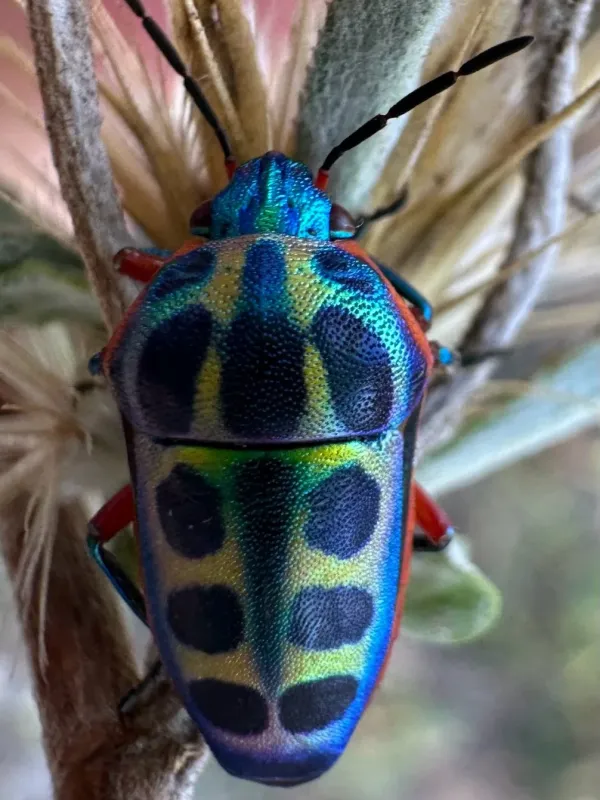
Calidea dregii belongs to the family Scutelleridae, commonly known as shield-backed bugs. These insects are easily recognized by their vivid, metallic, and often spotted coloration on their scutellum, which covers their wings.
Adult bugs typically range in size from 10 to 15 mm. They possess a robust piercing-sucking mouthpart, which is specialized for extracting plant sap from various parts of their host plants, such as stems and fruits.
The life cycle involves incomplete metamorphosis, moving through egg, nymph, and adult stages. Nymphs often differ in coloration from adults and tend to cluster together on the host plants.
This species is well-adapted to tropical and subtropical climates. Its activity peaks during the growing season when environmental conditions favor rapid reproduction and development.
Overwintering occurs primarily in the adult stage. During the cold season, these insects seek refuge in leaf litter, debris, or under tree bark to endure lower temperatures.
What it damages
The pest is primarily known for attacking cotton crops, but it also infests various legumes and other agricultural plants. It feeds by puncturing the plant tissue with its rostrum.
Feeding on flower buds and developing fruits causes severe physiological stress to the plant. This often leads to the abscission of buds and bolls, directly reducing the total yield.
Beyond direct sap loss, the feeding process introduces secondary pathogens into the plant. These fungi and bacteria can cause decay in cotton bolls, severely degrading the fiber quality.
The damage is particularly noticeable in areas with high infestation rates, where the cumulative impact of many bugs can lead to total crop failure if left unmanaged.
The presence of necrotic spots and deformed fruits serves as a clear indication of feeding activity, which negatively affects the market value of the produce.
Control measures
Integrated Pest Management (IPM) is the most effective approach for controlling this pest. It combines chemical, cultural, and biological strategies to keep populations below damaging levels.
Chemical control involves the timely application of systemic or contact insecticides. Applications should be timed based on field scouting to ensure maximum effectiveness during the early stages of infestation.
Cultural practices, such as removing weeds and cleaning up field residues, are vital for reducing overwintering sites. This disrupts the bug's life cycle and lowers initial population density.
Crop rotation serves as a preventive measure, as it limits the availability of host plants for consecutive seasons, making it harder for the pest population to establish itself.
Biological monitoring using pheromone or light traps helps farmers track population fluctuations. Protecting local populations of natural predators is also a key strategy in long-term control.
Taxonomy
- Latin name
- Calidea dregii
- Order
- Hemiptera (bugs, aphids, leafhoppers)
- Family
- Scutelleridae
- EPPO code
- CADEDR
Discussion
No discussions yet — be the first.