
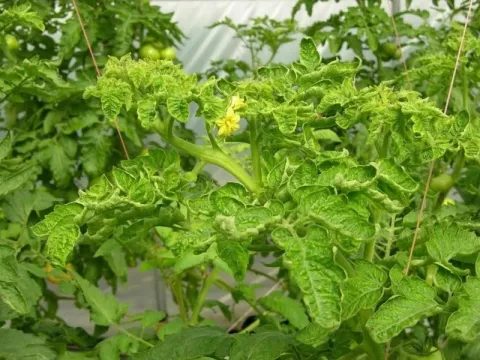
Tomato yellow leaf curl virus
Tomato yellow
Tomato yellow leaf curl virus (TYLCV) is a destructive plant pathogen belonging to the genus Begomovirus, family Geminiviridae. It contains a circular, single-stranded DNA genome that is highly prone to recombination.
What the section contains
Tomato yellow leaf curl virus
The virus is exclusively transmitted by the whitefly, Bemisia tabaci, in a persistent, circulative manner. The vector remains capable of transmitting the virus for several weeks after feeding on an infected host.
The virus does not spread via seeds or mechanical contact, making the control of the insect vector the primary focus of phytosanitary measures. It replicates within the phloem tissues of susceptible plants.
Molecular diagnostic tools, such as PCR and loop-mediated isothermal amplification (LAMP), are necessary for accurate identification. Serological methods like ELISA are also commonly used in field surveys.
Due to its high genetic variability, different strains of the virus exist globally. Understanding the specific strain in a region is crucial for successful breeding programs and resistance management.
TYLCV is a major threat to tomato production worldwide, especially in tropical and subtropical regions. While tomatoes are the primary host, the virus also affects other solanaceous crops like peppers and tobacco.
Infection results in severe stunting, leaf curling, and yellowing, which drastically reduces photosynthesis. Consequently, the production of fruits is severely compromised, often leading to total yield loss.
The economic impact is twofold: the cost of implementing stringent vector control and the loss of produce due to infected plants. Greenhouse operations are particularly vulnerable to rapid outbreaks.
Infestations often originate from weeds that harbor the virus in the off-season. When whiteflies migrate from these wild hosts to tomato fields, they initiate the primary infection cycle.
Exporting regions may face strict quarantine regulations if TYLCV is detected. Maintaining a disease-free environment is essential for global market access and sustainable production.
The most characteristic symptoms include chlorotic margins on leaves and upward curling. The leaflets become small, brittle, and exhibit a distinct yellowing, especially in younger plant tissues.
Plants infected at an early stage show severe stunting and may form a bushy appearance due to shortened internodes. Such plants often fail to develop further, appearing as if their growth has been suspended.
Flowering is significantly reduced, and plants often drop their buds before fertilization can occur. If fruits do form, they are typically undersized and deformed, lacking any commercial value.
Symptoms may vary depending on the plant cultivar and environmental stress factors. In some tolerant varieties, symptoms might be milder, but the plant remains a reservoir for the virus.
- Yellowing of leaf margins and interveinal chlorosis.
- Upward rolling and curling of leaves.
- Severe stunting of the main plant.
- Flower drop and fruit abortion.
- Excessive branching resulting in a bushy appearance.
Preventing whitefly entry into greenhouse facilities using fine-mesh insect-proof screens is the most critical step in managing TYLCV. This barrier significantly lowers the risk of primary infection.
Implementing a strict weeding program inside and around the production area is vital. Weeds act as a hidden reservoir for both the virus and its insect vector, facilitating the disease cycle.
Chemical control focuses on managing whitefly populations using systemic insecticides. A rotational spraying program is recommended to prevent the development of insecticide resistance in whiteflies.
The use of resistant or tolerant tomato hybrids is the most sustainable and efficient strategy. Research programs continue to integrate resistance genes into commercial lines to combat emerging strains.
Sanitation practices, such as removing crop residues immediately after harvest and maintaining a crop-free period, are effective strategies to reduce the population of vectors and inoculum sources.