
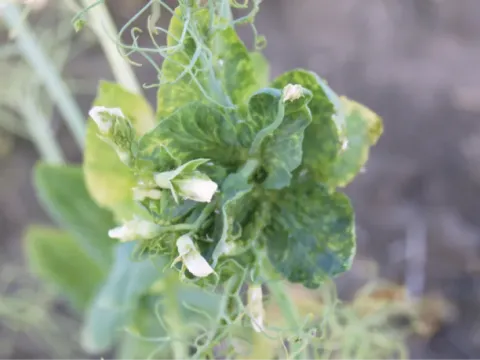
Pea seed-borne mosaic virus
Pea seed-borne
The causal agent is the Pea seed-borne mosaic virus (PSbMV), a member of the genus Potyvirus within the Potyviridae family. It is a highly contagious plant virus known for its primary transmission via infected seeds.
What the section contains
Pea seed-borne mosaic virus
The virus consists of flexuous filamentous particles containing a single-stranded RNA genome. It invades host plant cells and hijacks their internal machinery to produce viral proteins and replicate its genetic material.
The primary reservoir for the virus is infected seed stocks. Because the virus remains stable within the seed embryo, it can be dispersed over vast distances, making international seed trade a potential vector for the disease.
During the growing season, the virus spreads through aphid vectors in a non-persistent manner. This means that aphids can pick up the virus from an infected plant and immediately transmit it to a healthy one in a matter of seconds.
Laboratory diagnosis typically involves Enzyme-Linked Immunosorbent Assay (ELISA) or RT-PCR, which are essential for screening breeder seeds and ensuring the absence of the pathogen in commercial lots.
PSbMV attacks a wide range of legumes, with the most significant impact on peas (Pisum sativum), lentils, chickpeas, and faba beans. Both domestic and wild legumes can serve as hosts for the virus.
The infection causes systemic physiological stress in plants, leading to severe stunting and abnormal development. The disruption of nutrient transport impairs the overall vigor of the crop.
Yield losses can be catastrophic, often ranging from 30% to 50% in susceptible varieties. Infected plants produce fewer pods, and the seeds within are often wrinkled or discolored.
The economic impact is particularly severe in seed production sectors, where the detection of the virus leads to the condemnation of entire batches of high-value seeds.
Furthermore, plants weakened by the virus are more susceptible to secondary infections and environmental stresses, further compounding the losses experienced by farmers.
Early symptoms include a distinct mosaic or mottling pattern on the leaves, with alternating shades of light and dark green. Vein clearing is also a common diagnostic sign.
Plants affected by PSbMV often exhibit leaf curling and crinkling, particularly in the younger foliage near the growing tips. The stems may appear shortened, giving the plant a stunted, bushy appearance.
Pod symptoms are highly specific, featuring light-colored streaks or a characteristic netted pattern on the outer pod walls. In some cultivars, pods may remain flat or empty.
Flowering is frequently delayed, and in severe cases, the plant may abort its blossoms entirely, resulting in little to no yield formation.
- Mottled green mosaic pattern on leaves
- Leaf curling and deformation
- Significant stunting of the plant height
- Light streaks or net patterns on pods
- Reduced seed set and vitality
The most important control measure is the utilization of virus-tested, pathogen-free seeds. This prevents the initial introduction of the virus into the fields.
Spatial isolation of pea fields from other legumes or old perennial forage crops can significantly reduce the potential for virus spread by aphid populations.
Managing aphid vector populations using targeted insecticides can provide limited protection, although it is often insufficient to halt the spread once the virus is established in the field.
Breeding for genetic resistance is the ultimate goal in managing this virus. Resistant varieties allow for stable production even in the presence of viral pressure.
Integrated pest management (IPM) practices, including the removal of volunteer host plants and strict adherence to weed control, are essential to minimize the environmental reservoirs of the virus.