
Pea downy mildew
Western pea
Description
How to identify
The causative agent of the disease is the obligate parasite Peronospora viciae, an oomycete belonging to the order Peronosporales. It is a highly specialized pathogen that specifically targets pea plants.
The fungus survives in the soil as oospores, which can remain infectious for up to 7 years. Furthermore, the pathogen can be seed-borne, making contaminated seeds a primary source of early infection in new fields.
Secondary infection during the growing season is caused by sporangia, which are disseminated by wind, rain splashes, and irrigation systems. The pathogen enters the host plant through stomata or directly through the epidermis.
Optimal conditions for infection include cool temperatures ranging from 12°C to 18°C and high relative humidity (above 80%). The presence of free water on the leaves is essential for spore germination.
The fungus colonizes the intercellular spaces of host tissues. Under humid conditions, it emerges through the stomata to produce a visible layer of conidiophores and conidia on the leaf surface.
What it damages
Pea downy mildew affects all aerial parts of the plant, including leaves, stems, stipules, and pods. Severe infections can lead to significant biomass loss.
Stem infection causes deformation, stunted growth, and a reduction in the plant's overall height. This restricts the development of the entire canopy.
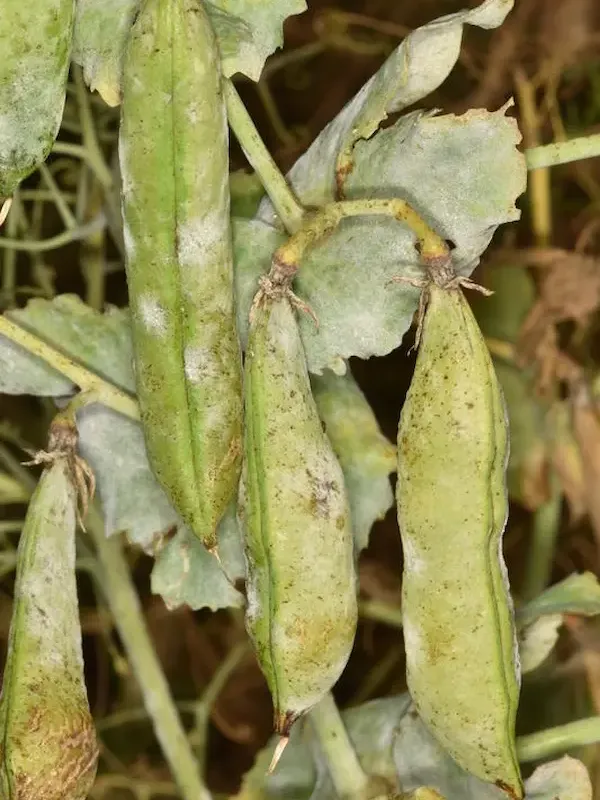
Infection of the pods leads to shriveled, malformed, and underdeveloped seeds. This directly reduces both the quantity and the nutritional quality of the yield.
The damage caused by the pathogen can result in yield losses ranging from 20% to 40% under favorable conditions for the disease. The overall productivity of the field is substantially compromised.
Furthermore, the forage quality of the pea green mass is degraded by the disease, rendering it less suitable for high-quality livestock feed production.
When it appears
Primary symptoms typically appear at the seedling stage (3–5 leaves), especially if the infection originated from infested soil or infected seeds.
The peak of disease development usually occurs during the flowering and pod-setting stages. The dense canopy creates a humid microclimate that favors rapid secondary spread.
In the second half of the growing season, warmer and drier weather conditions usually inhibit the activity of the pathogen, although the damage may already be done.
During the autumn, the fungus produces oospores within plant debris. These spores act as the long-term survival structure, ensuring the pathogen remains in the field for future seasons.
The incubation period is relatively short (5–12 days), allowing the fungus to complete several life cycles within a single growing season if conditions remain favorable.
Signs of infestation
Yellowish, indefinite, and chlorotic spots appear on the upper surface of the leaves. These spots lack distinct boundaries and may eventually turn brown.
A distinctive greyish-violet or whitish downy fungal growth appears on the underside of the leaves, directly beneath the yellow spots.
As the disease progresses, the affected leaves turn yellow, curl downwards, and eventually become necrotic and dry out, leading to premature leaf drop.
Stems may exhibit swelling and necrotic lesions. During periods of high humidity, the grey fungal growth can also be observed on the stems and stipules.
- Yellowish chlorotic spots on the upper leaf surface.
- Greyish-violet downy growth on the underside of leaves.
- Curling and wilting of affected foliage.
- Stunted growth and deformation of stems.
- Malformed, shriveled pods with reduced seed yield.
Control measures
The use of resistant cultivars is the most effective long-term strategy for managing pea downy mildew and minimizing the reliance on fungicides.
Implementing a proper crop rotation with a gap of at least 4–5 years between pea crops is essential to reduce the inoculum level of oospores in the soil.
Treating seeds with appropriate systemic fungicides is a crucial step to prevent seed-borne infection and protect seedlings during the early stages of growth.
In-season management involves monitoring fields for early symptoms and applying foliar fungicides (such as strobilurins or copper-based compounds) when conditions are conducive to disease spread.
Post-harvest management, including deep tillage and burial of crop residues, helps accelerate the decomposition of infected material and reduces the overall inoculum pressure for the next season.
Causes diseases · 1
Discussion
No discussions yet — be the first.