
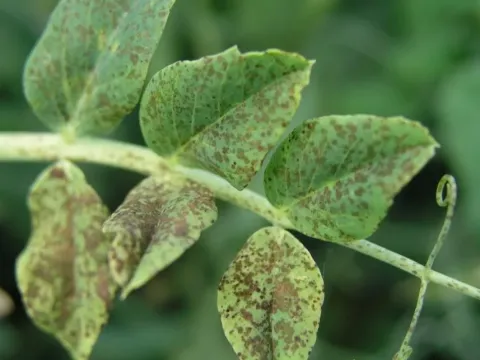
Pea phoma
Phoma pinodella
The causal agent of pea phoma is the fungus Phoma pinodella, classified within the Phylum Ascomycota, Order Pleosporales, and Family Didymellaceae.
What the section contains
Pea phoma
This pathogen is characterized by the production of pycnidia, which are asexual fruiting bodies that contain conidia, facilitating the spread of the disease.
The fungus is known to survive in crop residues and soil for several years through the production of dormant mycelia and resilient chlamydospores.
As a hemibiotroph, it initially colonizes living plant tissues and continues to thrive as a saprotroph on necrotic tissue, completing its life cycle.
Molecular identification techniques are often required to distinguish Phoma pinodella from other related species such as Ascochyta pisi in field diagnostics.
Pea phoma affects a wide range of pulse crops, with field peas (Pisum sativum) being the most economically significant host for this pathogen.
The disease causes foot rot, which destroys the root system and the lower part of the stem, leading to poor crop establishment and stunted growth.
Foliar lesions significantly reduce the green leaf area, limiting the photosynthetic capacity of the plants during critical developmental stages.
Seed-borne infection is a major problem, as it reduces seed quality, germination rates, and introduces the pathogen into non-infested fields.
In cases of severe infestation, total crop failure or major yield losses occur, forcing farmers to rely on expensive chemical interventions.
Infection starts from contaminated seeds or survival structures present in the soil from previous pea or legume crops.
Primary inoculum, in the form of spores, is splashed onto the lower foliage and stems by rain or irrigation water during the early growing season.
Warm and humid weather conditions are optimal for the development of the fungus, with peak infection occurring during periods of continuous rainfall.
The spread of the disease continues throughout the growing cycle, especially when the canopy density promotes high humidity at the soil surface.
In late stages, the fungus may invade maturing pods, ensuring the transfer of the pathogen to the next generation through contaminated seeds.
Symptoms initially appear as dark, reddish-brown lesions at the base of the stem or on the roots, often referred to as "foot rot".
Leaves exhibit small, dark spots with distinct margins that can coalesce, causing the leaf tissue to wither and eventually fall off.
Small black fruiting bodies (pycnidia) become visible within the necrotic lesions, which is a definitive sign of Phoma species presence.
Stunted plant growth, uneven height in the field, and premature yellowing of the foliage are common signs of root-related damage caused by the pathogen.
On pods, infection appears as dark, sunken spots that may extend to the seeds, resulting in discoloration and shriveling of the pea grain.
The primary control strategy involves using high-quality, disease-free seed stocks to prevent initial field introduction.
Implementing a crop rotation of at least 3 to 4 years between susceptible pulse crops is essential to break the survival cycle in the soil.
Effective management of crop residues through tillage encourages decomposition and limits the survival of the fungus in the field environment.
Seed treatments with registered fungicides are necessary to protect emerging seedlings from soil-borne and seed-borne inoculum.
Foliar application of fungicides during the flowering phase can be effective in reducing disease spread if weather conditions are conducive to infection.