
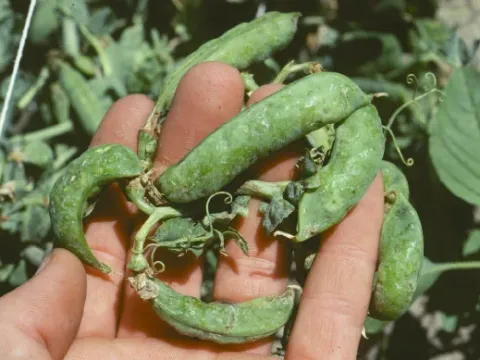
Pea enation mosaic virus
Pea enation
Pea enation mosaic virus (PEMV) is a destructive plant pathogen that belongs to the Enamovirus genus, family Solemoviridae. It is an isometric virus containing single-stranded RNA, known for its ability to cause severe systemic infections in leguminous crops.
What the section contains
Pea enation mosaic virus
The transmission of this virus is strictly dependent on insect vectors, primarily various aphid species. The virus is transmitted in a persistent, circulative manner, meaning that once an aphid feeds on an infected plant, it remains infectious for a long period of its life.
PEMV has a wide host range among the Fabaceae family, including peas, broad beans, lentils, and vetch. In temperate regions, it survives the winter in perennial legumes or weed hosts, which serve as a primary reservoir for the subsequent growing season.
Biological dispersal is heavily influenced by aphid migration patterns. In warm and dry climatic conditions, aphid populations can explode, leading to rapid and widespread transmission of the virus across pea fields.
Since the virus does not spread through seeds, the entire management strategy focuses on breaking the cycle between the reservoir hosts, the aphid vectors, and the healthy pea crop.
The primary economic damage is sustained by pea (Pisum sativum) crops. The virus colonizes the plant's phloem, causing systemic disruption that affects every physiological process, from photosynthesis to nutrient translocation.
Infected plants exhibit severe stunting and reduced biomass, which drastically lowers the overall yield potential. In many cases, early-season infections lead to a complete loss of crop viability, as the plants fail to set pods or develop viable seeds.
Quality reduction is another major concern. The grains harvested from infected plants are often shriveled, discolored, or undersized, rendering them unsuitable for both commercial food processing and seed markets.
Secondary infections are a frequent consequence of PEMV. Because the virus severely weakens the plant's defensive systems, infected fields often suffer from concurrent fungal and bacterial diseases that would otherwise be manageable.
The agricultural impact is compounded by the costs of aphid control programs. Protecting fields requires repeated insecticide applications, which increase production costs and impact the overall sustainability of the crop cycle.
The name of the virus comes from its most characteristic symptom: 'enations', which are small, comb-like outgrowths that develop on the undersides of the leaves and stipules, particularly along the veins.
Early signs include a noticeable mosaic pattern—light and dark green mottling—on the leaves. Over time, the leaves become thickened, crinkled, and distinctly deformed, showing significant leaf curling.
The apex (growing point) of the plant often appears twisted or bush-like due to suppressed internode growth. This leads to severe stunting, where plants fail to reach their expected height, causing a ragged appearance in the field.
Flower development is severely impaired, often leading to flower drop or the formation of deformed, empty pods. When seeds do form, they are often few in number and poor in quality.
- Mottling and chlorotic mosaic on foliage.
- Characteristic leaf enations (ridges).
- Deformed, crinkled leaf blades.
- Severe plant stunting and reduced internode length.
- Deformed pods and poor seed development.
The most effective management tool is the control of aphid vectors. Using systemic insecticides during the early vegetative stages can significantly reduce the rate of virus transmission by killing aphids before they can transmit the virus.
Spatial isolation is a recommended practice. Planting new pea crops away from older perennial legume stands or overwintering sites minimizes the initial source of inoculum for the new generation of plants.
Weed management within and around the field is crucial. By eliminating host plants that harbor the virus, farmers can reduce the risk of primary infection entering their pea crops during the critical early growing period.
The use of resistant or tolerant cultivars is the cornerstone of integrated disease management. Genetic resistance provides a reliable and cost-effective way to mitigate the risk of PEMV, especially in high-pressure environments.
Adjusting planting dates to ensure that the most sensitive stages of plant growth do not coincide with the peak population density of aphid vectors is a key strategic move for farmers to maintain healthy yields.