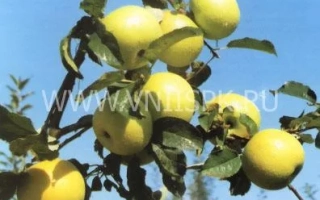
A late-winter variety developed by the Dagestan Fruit Cultivation Experimental Station through geographically distant hybridization of the Western European variety 'Renet Champagne' with the valuable local Dagestan variety 'Mig-Inc (Ice)'.
Widely grown in the foothill and plain fruit zones of Dagestan, officially registered in the foothill zone and the northern mountain valley subzone of the mountainous zone of the Republic of Dagestan.
The tree is medium-sized and fast-growing, with a high-rounded crown in its youth and a broad, slightly flattened rounded crown in fruiting. Predominant fruiting forms: simple and complex clusters, rarely fruiting on terminal growth tips.
Branches of medium length, thick, straight or occasionally slightly curved, round in cross-section, brown or brownish-brown. Leaves large, broad, egg-shaped, smooth, dark green, with upward-curving large serrated edges. Petioles of medium length and thickness with elongated stipules.
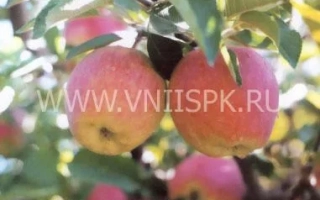
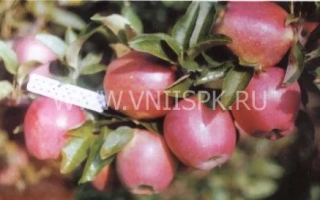
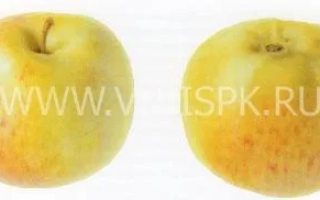
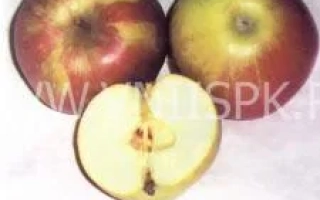
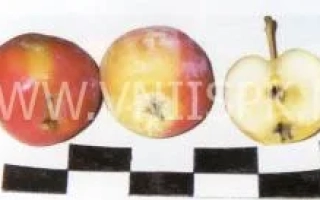
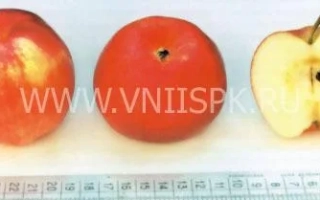
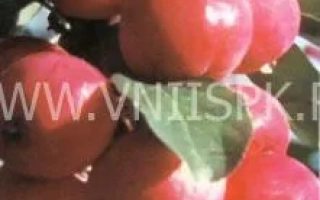
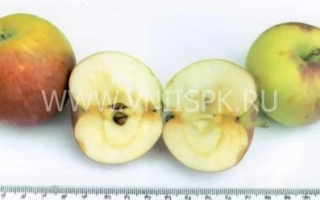
Fruits (see photo) large, occasionally medium-sized, one-dimensional, round-conical or cylindrical, tapering toward the apex. Fruit surface smooth, without ridges, occasionally slightly ribbed.
Fruits have a symmetrical, regular shape. Main color — golden-yellow; covering color — predominantly on the fruit surface, strongly expressed, blurred, bright red. Peduncle of medium length and thickness. Calyx of medium size, closed. Sub-calyx tube short, narrow, funnel-shaped. Seed chambers medium-sized, open or semi-open. Seeds large, broad, narrowly egg-shaped, occasionally conical, dark brown with a reddish tint. Central cavity narrowly elliptical in shape.
Flesh light-yellow, firm, slightly prickly, fine-grained, very juicy, tart-sweet, with a strong specific aroma, excellent taste qualities (4.6-4.7 points). Chemical composition of the fruit: dry matter — 15%, total sugars — 11.4%, titratable acidity — 0.52%, ascorbic acid — 12.1 mg/100g.
Ripens late-winter (harvest 5-15 October) and has exceptional long-term storage capability. In standard semi-basement fruit storage facilities (with active ventilation), fruits can be stored up to 200 days and are suitable for fresh consumption.
Partially self-fertile; best pollenizer varieties: 'Renet Champagne', 'Jonathan', 'Golden Delicious', 'Welspur'.
Early-bearing variety, begins fruiting at age 5-6 on strong rootstocks, and at age 3-4 on medium-sized clonal rootstocks — EM5, EM7. High yield (233-586 tons/ha) and annual. Moderate winter hardiness. Resistant to fungal diseases.
Advantages of the variety: resistance to fungal diseases, early fruiting, annual and high yield, large and attractive fruits with high taste quality and long storage life.
Disadvantages of the variety: not very high winter hardiness, late completion of vegetation, meaning trees enter dormancy with partially unfallen leaves.
The variety is the best donor for developing early-bearing, high-yielding, disease-resistant, adaptable varieties with high commercial quality and long storage life fruits.