


SKU #3342
·
379 views
Ermakovskoye Gornoye
Apple
User rating
1 vote100% positive reviews
No ratings yet — be the first.
Type of Sort
Summer apple variety
Store offers · 1 from 1 stores
Prices are updated on loadLoading offers…
Available at: Astrasad · Садовая Деревня
Aggregator catalog: prices are collected automatically from store websites, normalized by AI and converted at the current exchange rate. Before ordering, confirm the price and availability on the store's website. This block is not indexed by search engines — the data is loaded after the page opens.
About product

This summer variety was obtained at the Siberian Institute of Horticulture named after M. A. Lisavenko from a cross between Phoenix Altai and Altai Blue in 1965. Breeders: M. A. Lisavenko, I. P. Kalinina, N. V. Ermakova. It is widely grown in the foothills and mountainous zones of the Altai region. Included in the State Register for the West Siberian region.
Trees are moderately low-growing wi…
Type of Sort
Summer apple variety
Description
This summer variety was obtained at the Siberian Institute of Horticulture named after M. A. Lisavenko from a cross between Phoenix Altai and Altai Blue in 1965. Breeders: M. A. Lisavenko, I. P. Kalinina, N. V. Ermakova. It is widely grown in the foothills and mountainous zones of the Altai region. Included in the State Register for the West Siberian region.
Trees are moderately low-growing with rounded, moderately dense crowns. Branches are curved, emerging from the trunk at nearly straight angles. Fruits form on ring buds, spurs, and short fruiting shoots.
Shoots are thick, straight, brownish-brown, hairy, with numerous small stipules. Leaves are large, elongated, lanceolate, with spirally twisted tips, green, smooth, matte, and hairy on the underside. The leaf blade is curved downward with coarse-toothed margins. Petioles are long, thick, hairy; stipules are small, sickle-shaped.
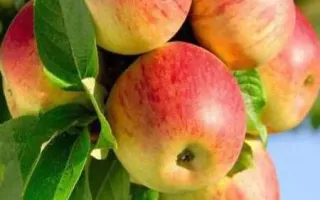
Fruits (see illustration) are small (67–80 g), round, with smooth surface. Main color is light yellow, overlying color is bright red, mottled with stripes covering most of the fruit, with large, clearly visible subcutaneous dots. Peduncles are medium length, thin, with medium-sized, non-oxidized or occasionally weakly yellowish-brown indentations. Calyx is medium-sized. Calyx tube is medium, usually cup-shaped. Seed chambers are closed.
Flesh is white, fine-grained, juicy, slightly acidic-sweet, flavorful, with aroma. Chemical composition of fruits: total sugar content — 11.5% (10.9–12.1), titratable acids — 0.6% (0.57–0.74), ascorbic acid — 23.9 mg/100g (8.2–39.6), P-active compounds — 127 mg/100g (87–167), pectic substances — 1.23% on dry weight.
Fruits ripen in the second decade of August, and can be stored for up to 30 days. This variety is universal in use, intended for summer consumption.
Fruit production begins on the 4th–5th year. Yield is moderate, fruiting is not sharply periodic. Winter hardiness is moderate. Resistance to leaf spot is moderate; fruits are highly resistant.
Advantages of the variety: low growth, good taste, suitable for summer consumption, relatively large fruits for Siberian conditions.
Disadvantages of the variety: moderate resistance to leaf spot.
Crop & resistance
Crop
Disease resistance
Specifications
| Type of Sort | |
|---|---|
| Catalog | Catalog → Apple |
Not yet комментариев. Be the first!
Alternatives
Apple saplings · similar varieties





See also
Often considered together with this variety


Recently viewed
Products you’ve viewed on this site
Reviews · 0