


SKU #3328
·
1 165 views
Apple Jonared (Jonathan Red)
Apple
User rating
0 votes0% positive reviews
No ratings yet — be the first.
Type of Sort
Winter Apple Variety
Store offers · 3 from 3 stores
Prices are updated on loadLoading offers…
Available at: AYRIS · Чудеса Саду · Экосад · Sadovnikoff
Aggregator catalog: prices are collected automatically from store websites, normalized by AI and converted at the current exchange rate. Before ordering, confirm the price and availability on the store's website. This block is not indexed by search engines — the data is loaded after the page opens.
About product

Late-winter variety of American origin. Selected as a spontaneous bud mutation of the Jonathan variety. Differing from the original variety by more intense fruit coloration, but less pronounced dessert qualities, longer and thinner leaves with long petioles. Registered in the North Caucasus region. Currently, it is practically not found in new plantings. Medium-stature trees with a medium-den…
Type of Sort
Winter Apple Variety
Description
Late-winter variety of American origin. Selected as a spontaneous bud mutation of the Jonathan variety. Differing from the original variety by more intense fruit coloration, but less pronounced dessert qualities, longer and thinner leaves with long petioles.
Registered in the North Caucasus region. Currently, it is practically not found in new plantings.
Medium-stature trees with a medium-dense, rounded canopy.
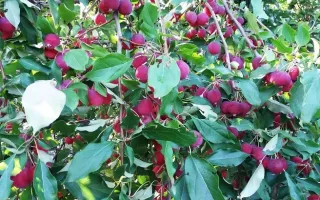
Fruits (see illustration) of medium to larger size, flat-round or round-conical shape with small ribs, non-uniform. Main color is yellow-green, and by harvest time, fruits are covered with almost continuous bright dark crimson blush with a raspberry tint. On some fruits, there may be a rusty netting.
Flesh is yellowish-white, juicy, firm, with typical Jonathan dessert flavor.
Fruits are harvested in late September, stored until April, but during storage, fruits are susceptible to wilting and spotting, though to a lesser extent than Jonathan.
The variety is insufficiently winter-hardy, severely affected by powdery mildew, but fairly resistant to scab.
Advantages of the variety: fruits of high commercial and consumer quality.
Disadvantages of the variety: insufficient winter hardiness and strong susceptibility to powdery mildew.
Crop & resistance
Crop
Disease resistance
Specifications
| Type of Sort | |
|---|---|
| Catalog | Catalog → Apple |
Not yet комментариев. Be the first!
Alternatives
Apple saplings · similar varieties


See also
Often considered together with this variety




Recently viewed
Products you’ve viewed on this site
Reviews · 0