


SKU #3346
·
378 views
Desirable
Apple
User rating
0 votes0% positive reviews
No ratings yet — be the first.
Type of Sort
Summer apple variety
Store offers · 2 from 2 stores
Prices are updated on loadLoading offers…
Available at: Сад от А до Я · Все для сада · Agromir
Aggregator catalog: prices are collected automatically from store websites, normalized by AI and converted at the current exchange rate. Before ordering, confirm the price and availability on the store's website. This block is not indexed by search engines — the data is loaded after the page opens.
About product

Variety with late-ripening fruits from the All-Russian Research Institute of Fruit Crop Selection, obtained through open pollination of the McIntosh variety. Breeders: E. N. Sedov, Z. M. Serova, N. G. Krasova. In 1999, the variety was accepted for state testing in the Central Chernozem region. It was officially approved for cultivation since 2002.
Tree is vigorous with a round crown. Main bran…
Type of Sort
Summer apple variety
Description
Variety with late-ripening fruits from the All-Russian Research Institute of Fruit Crop Selection, obtained through open pollination of the McIntosh variety. Breeders: E. N. Sedov, Z. M. Serova, N. G. Krasova. In 1999, the variety was accepted for state testing in the Central Chernozem region. It was officially approved for cultivation since 2002.
Tree is vigorous with a round crown. Main branches are curved, spaced apart, and emerge from the trunk at nearly a right angle. Branch tips are directed upward. Bark on the trunk and main branches is smooth and gray.
Shoots are weakly knotted, round in cross-section, reddish-brown, hairy. Buds are small, pressed, conical, hairy. Leaves are large, round, slightly pointed, green, smooth, matte, with delicate venation. Leaf blade is concave and curved downward. Leaf margin is doubly toothed, smooth. Petiole is thick, hairy, with anthocyanin coloration at the base.
Flower buds are large, hairy. Flowers are large, dish-shaped, nearly flat, buds are white-pink with a purple tint, petals are pale pink, round, slightly closed, stigma level with or below the stamens.
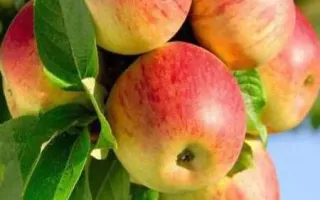
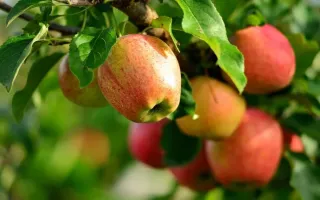
Fruits (see illustration) are medium-sized, flattened, weakly ribbed, slightly tapered at the apex. Fruit skin is delicate, smooth, dry, glossy, with a weak waxy coating. Main fruit color at harvest is greenish-yellow; at consumer ripeness — light yellow. Cover color occupies nearly the entire fruit surface as a blurred reddish blush and dark red stripes. Numerous gray, clearly visible lenticels are present. Fruit stem is short and straight. Calyx is medium-depth, acute-conical, narrow. Receptacle is half-open. Dish is small, weakly ribbed. Heart is large, heart-shaped. Seed chambers are small and closed. Subcalyx tube is conical. Seeds are medium-sized, conical, dark brown.
Fruit flesh is white, slightly creamy, tender, finely grained, juicy, with a slightly acidic-sweet flavor and mild aroma. Appearance rating: 4.6; flavor rating: 4.4. Chemical composition of the fruit: total sugars 10.8%, titratable acids 0.61%, ascorbic acid content 3.7 mg/100g, P-active substances 380 mg/100g.
Fruit harvest in Orlovskaya Oblast occurs at the end of August to early September; consumer period extends until mid-September.
Variety is of medium fruiting speed and high yield. Average yield over 1996–1999 was 207 centners per hectare. Cold hardiness exceeds that of Melba. During the winter of 1994–1995, when snow surface temperature dropped to -36.7ºC, tree damage was rated at 1.1 points, whereas Melba trees suffered at 1.6 points. Variety is resistant to scab and significantly exceeds Melba in this regard.
Advantages of the variety: high commercial and consumer fruit quality (dessert flavor), cold hardiness.
Disadvantages of the variety: relatively tall trees.
Suitable for cultivation in intensive orchards on dwarf and semi-dwarf rootstocks.
Video · 3 videos
Suggest a video →Crop & resistance
Crop
Disease resistance
Specifications
| Type of Sort | |
|---|---|
| Catalog | Catalog → Apple |
Not yet комментариев. Be the first!
Alternatives
Apple saplings · similar varieties





See also
Often considered together with this variety


Recently viewed
Products you’ve viewed on this site
Reviews · 0