


SKU #3330
·
293 views
Divo
Apple
User rating
1 vote100% positive reviews
No ratings yet — be the first.
Type of Sort
Summer apple variety
Tree; Growth Power
Slightly Undergrown
Tree; Canopy Shape
Round Canopy
Fruit; Fruit Shape
Flat-round
Store offers · 1 from 1 stores
Prices are updated on loadLoading offers…
Available at: Agromir
Aggregator catalog: prices are collected automatically from store websites, normalized by AI and converted at the current exchange rate. Before ordering, confirm the price and availability on the store's website. This block is not indexed by search engines — the data is loaded after the page opens.
About product

Variety selected at the Central Siberian Botanical Garden (CSBG) of the Siberian Branch of the Russian Academy of Sciences. Breeders: V. N. Vasil'eva, N. V. Moiseeva, E. T. Safonova. Obtained by crossing 'Skalепovka' with 'Belyy Naliv'. It has gained popularity across various regions of Siberia, the Urals, and the Far East, especially in home gardening.
The tree is low-growing, forming a low-t…
Type of Sort
Summer apple variety
Tree; Growth Power
Slightly Undergrown
Tree; Canopy Shape
Round Canopy
Fruit; Fruit Shape
Flat-round
Description
Variety selected at the Central Siberian Botanical Garden (CSBG) of the Siberian Branch of the Russian Academy of Sciences. Breeders: V. N. Vasil'eva, N. V. Moiseeva, E. T. Safonova. Obtained by crossing 'Skalепovka' with 'Belyy Naliv'. It has gained popularity across various regions of Siberia, the Urals, and the Far East, especially in home gardening.
The tree is low-growing, forming a low-trunked shape (trunk 20-30 cm). The crown is round and compact, of medium density. Branches are straight, oriented upwards. Fruit clusters are in rings.
Shoots are straight, round in cross-section, yellow-brown, moderately hairy. Leaves are medium-sized, slightly pointed, dark green, matte, moderately hairy, with delicate venation and serrated-crenate edges. Petioles are of medium length, with lanceolate bracts.
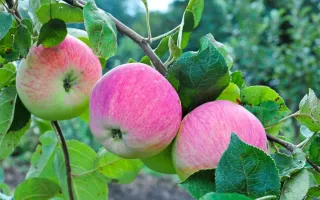
Fruits (see photo) are flat-round, medium-sized (up to 38 g), bright raspberry-red, very attractive. Pedicels are short, thick, straight. The calyx is non-dehiscent, half-open, with a short, shallow calyx tube. Seed chambers are half-open, with brown egg-shaped seeds.
Flesh is white, juicy, fine-grained, sweet-sour with a hint of spice. Chemical composition of fruits: total sugars — 11.4% (9.0-16.8%), titratable acids — 1.57% (1.07-2.1%) on fresh weight, tannins — 0.18% on fresh weight, ascorbic acid — 31.5 mg/100g (24.5-42.6 mg/100g), polyphenols (catechins) — 185 mg/100g (101-396 mg/100g), pectin substances — 0.75% (0.41-1.2%) on fresh weight.
Fruits ripen at the end of August and can be stored until the end of October.
Fruits are consumed fresh and are excellent for processing. Compotes have an attractive appearance and a delicate, pleasant flavor and aroma. Puree and juice are brightly colored and aromatic, which is highly valuable for confectionery production. For making compotes, fruits are used whole with the pedicel.
Fruit production begins on the 4th-5th year. The variety is hardy, moderately productive (up to 93 kg per tree). It is winter-hardy.
Advantages of the variety: high winter hardiness, good yield, early ripening, high-vitamin and high-tech fruits, low-growing trees with crowns convenient for mechanized care and harvesting.
Disadvantages of the variety: towards the end of its productive period, it loses resistance to fungal diseases, especially if preventive measures are not taken.
The variety 'Divo' is a valuable genetic source for breeding for winter hardiness, high yield, high vitamin content in fruits, controlled tree growth, early ripening, and high fruit technology. At CSBG, various crosses of this variety with the best Siberian and European large-fruited varieties and selected forms of wild apple 'Siver's' have been performed. Selection of promising forms continues from the hybrid stock.
Video · 2 videos
Suggest a video →Crop & resistance
Crop
Specifications hover over for a hint about the specification
| Type of Sort | |
|---|---|
| Tree; Growth Power | |
| Tree; Canopy Shape | |
| Fruit; Fruit Shape | |
|
Fruit; flesh color
Fruit; flesh color
Color of the fruit flesh. There are red, pink, yellow, and brown colors. |
|
| Fruit; Fruit mass | 38 |
| Fruit; Lying | 2 |
| Cold Resistance | |
| Catalog | Catalog → Apple |
Not yet комментариев. Be the first!
Alternatives
Apple saplings · similar varieties



See also
Often considered together with this variety





Recently viewed
Products you’ve viewed on this site
Reviews · 0