


SKU #3334
·
248 views
Dolinskoe
Apple
User rating
0 votes0% positive reviews
No ratings yet — be the first.
Type of Sort
Winter Apple Variety
About product

Early winter variety selected by the North Caucasus Research Institute of Mountain and Piedmont Horticulture. Obtained by hybridization of London Pippin with Snowy Calville. Breeders: P. P. Kostyk, R. S. Shidakov, O. A. Varkvasov, V. N. Berbekov. Variety registered in the Kabardino-Balkar Republic. Tree vigorous. Crown wide-round, dense. Trunk with smooth, grayish-brown bark. Main branches of…
Type of Sort
Winter Apple Variety
Description
Early winter variety selected by the North Caucasus Research Institute of Mountain and Piedmont Horticulture. Obtained by hybridization of London Pippin with Snowy Calville. Breeders: P. P. Kostyk, R. S. Shidakov, O. A. Varkvasov, V. N. Berbekov. Variety registered in the Kabardino-Balkar Republic.
Tree vigorous. Crown wide-round, dense. Trunk with smooth, grayish-brown bark. Main branches of medium thickness with smooth, light-brown bark. Fruit set on short fruiting spurs and buds.
Shoots light-brown, straight, moderately thick, internodes of medium length. Leaves medium-sized, elongated-oval, dark green, smooth with coarse venation, large wavy-edged margins, petiole of medium length, thick. Bracts of medium size, elongated.
Flowers of medium size, cup-shaped, pink, aromatic. Petals large. Stigmas of medium length, densely hairy, stigma slightly above the anthers.
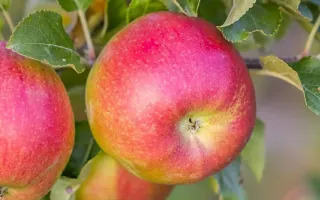
Fruits of medium size (150 g), one-seeded, flattened, slightly ribbed, well-shaped. Skin smooth, oily, glossy. At harvest maturity, main color is light green; at consumer maturity — golden-yellow. Pedicel of medium length and thickness. Calyx persistent, half-closed. Receptacle of medium size, narrow. Seed chambers half-closed, medium size, with medium-sized brown, elongated-oval seeds. Calyx tube of medium length, funnel-shaped.
Flesh dense, light-yellow, juicy, tender, slightly sour-sweet taste with moderate aroma. Contains: sugars — 9.0%, titratable acids — 0.58%, ascorbic acid — 11.2 mg/100g.
Early winter ripening.
Fruits stored until January.
Fruit set begins on the 4th-5th year after planting in the orchard. High yield. Moderate resistance to scab and powdery mildew.
Advantages of the variety: fruits of high commercial quality (uniform, bright-yellow, excellent dessert flavor), high field resistance to scab and powdery mildew.
Disadvantages of the variety: tall, large tree.
Crop & resistance
Crop
Disease resistance
Specifications
| Type of Sort | |
|---|---|
| Catalog | Catalog → Apple |
Store offers
Prices are updated on loadLoading offers…
Aggregator catalog: prices are collected automatically from store websites, normalized by AI and converted at the current exchange rate. Before ordering, confirm the price and availability on the store's website. This block is not indexed by search engines — the data is loaded after the page opens.
Not yet комментариев. Be the first!
Alternatives
Apple saplings · similar varieties




See also
Often considered together with this variety


Recently viewed
Products you’ve viewed on this site
Reviews · 0