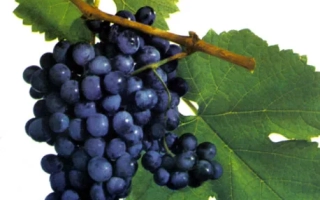
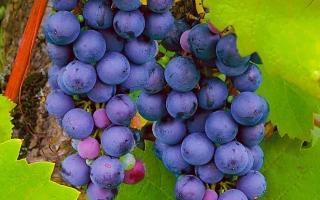
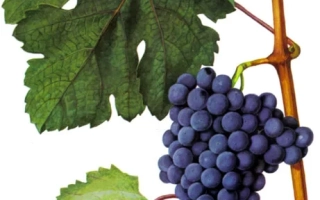
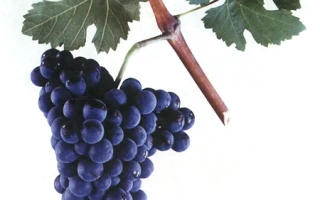
Saperavi is an ancient Georgian grape variety belonging to the eco-geographical group of the Black Sea basin. The bushes are sprawling, featuring egg-shaped whole leaves that turn yellow with wine-red spots in autumn. The leaves are of medium size, round or egg-shaped, with raised edges and dense web-like pubescence underneath. Young shoots are light brown with a grayish tint, while the flowers are perfect (bisexual). The clusters are broadly conical, of medium size, loose and often branched, with herbaceous stems up to 4.5 cm long. The berries are oval, dark blue with a thick waxy bloom, juicy flesh, and thin but tough skin. The berry juice is lightly colored with a pleasant and fresh taste. The variety is characterized by a late maturity period—berries reach ripeness in late September to early October in regions with a temperate climate. The vegetative period is about 150-160 days at an active temperature sum of 2900-3000 °C. Saperavi boasts high and stable yields, reaching 90-110 centners per hectare. The bushes have medium growth vigor, and annual shoots ripen well. However, the variety is susceptible to significant flower and berry drop, and berries may be affected by gray mold in rainy weather. The variety has relatively high winter hardiness, but bud damage is possible at temperatures below minus 20 °C. Saperavi grapes are widely used for producing premium table and dessert wines. Young wine is light and pleasant in taste, while with age it becomes viscous and tannic. The wine bouquet can capture notes of blackcurrant, pomegranate, cherry, ripe blackberry, and prune. The variety actively accumulates sugars—sugar content in the berries varies from 17 to 21 g/100 ml, reaching 26-28 g/100 ml in some regions, while acidity decreases slowly. Thanks to these qualities, Saperavi is valued for creating rich and harmonious wines with a rich aromatic profile.