

SKU #72841
·
52 views
CRIMEAN ROSEMARY
Thyme
User rating
0 votes0% positive reviews
No ratings yet — be the first.
Herbs
Thyme
Plant Height
15-30
Growth Form
Shrub
Leaf Color
Green
About product

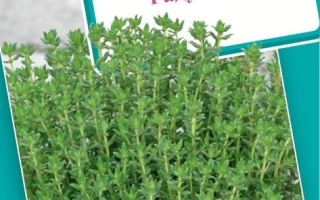
Crimean Rosemary is a variety of a perennial herbaceous plant of the mint family, belonging to the genus Thymus. It is characterized by a compact height of about 23 cm and erect stems that become woody at the lower part, giving the bush stability and an orderly appearance. Leaves are small (7–9 mm long and 2 mm wide), light green, short-stalked and opposite; their edges are entire and slightly cur…
Herbs
Thyme
Plant Height
15-30
Growth Form
Shrub
Leaf Color
Green
Description
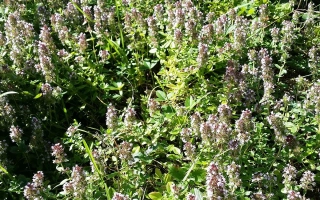
Crimean Rosemary is a variety of a perennial herbaceous plant of the mint family, belonging to the genus Thymus. It is characterized by a compact height of about 23 cm and erect stems that become woody at the lower part, giving the bush stability and an orderly appearance. Leaves are small (7–9 mm long and 2 mm wide), light green, short-stalked and opposite; their edges are entire and slightly curled downwards, creating the plant's characteristic appearance.
Crimean Rosemary has a high essential oil content – on average 0.65 % of the mass of fresh raw material. When harvesting from one hectare, about 62 kg of oil can be obtained, and its composition is predominantly linalool (about 81 %). This makes the variety valuable both for aromatherapy and for the food industry, where a natural aromatic component is required.
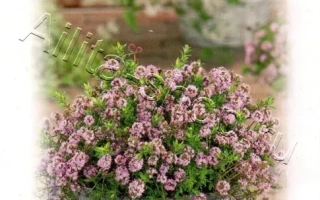
The plant grows well in dry, sandy places with good drainage, which is typical for the climate of the Crimean Peninsula. Thanks to its compact form and resistance to drying out, Crimean Rosemary is easy to grow both in open garden beds and in containers. It is also suitable for use as a decorative plant in gardens thanks to its small flowers (purple, pink, or white) and compact growth up to 35 cm. Overall, Crimean Rosemary is a practical and fragrant thyme variety suitable both for the commercial production of essential oils and for home growing.
Crimean Rosemary has a high essential oil content – on average 0.65 % of the mass of fresh raw material. When harvesting from one hectare, about 62 kg of oil can be obtained, and its composition is predominantly linalool (about 81 %). This makes the variety valuable both for aromatherapy and for the food industry, where a natural aromatic component is required.
The plant grows well in dry, sandy places with good drainage, which is typical for the climate of the Crimean Peninsula. Thanks to its compact form and resistance to drying out, Crimean Rosemary is easy to grow both in open garden beds and in containers. It is also suitable for use as a decorative plant in gardens thanks to its small flowers (purple, pink, or white) and compact growth up to 35 cm. Overall, Crimean Rosemary is a practical and fragrant thyme variety suitable both for the commercial production of essential oils and for home growing.
Crop & resistance
Crop
Specifications
| Herbs | |
|---|---|
| Plant Height | 15-30 |
| Growth Form | |
| Leaf Color | |
| Flower Color | |
| Assignment | |
| Registration year | 2020 |
| Catalog | Catalog → Thyme |
| Legal data |
Show · 1 |
| Country | Russia |
Store offers
Prices are updated on loadLoading offers…
Aggregator catalog: prices are collected automatically from store websites, normalized by AI and converted at the current exchange rate. Before ordering, confirm the price and availability on the store's website. This block is not indexed by search engines — the data is loaded after the page opens.
Not yet комментариев. Be the first!


AYBOLIT
Сельскохозяйственное Селекционно-производственное Предприятие Сортсемовощ
061 1 offer
0.15 € ≈ 8 ₴

See also
Often considered together with this variety





Recently viewed
Products you’ve viewed on this site
Reviews · 0