


SKU #65196
·
67 views
PETERSBURG PURPLE RADISH
Radish
User rating
0 votes0% positive reviews
No ratings yet — be the first.
Redis Type
Radish
Growing Period
Spring, Autumn
Maturation Period
18 - 20 days
Root vegetable; weight
25 - 30 grams
Store offers · 1 from 1 stores
Prices are updated on loadLoading offers…
Available at: Fermery · Гелиос
Aggregator catalog: prices are collected automatically from store websites, normalized by AI and converted at the current exchange rate. Before ordering, confirm the price and availability on the store's website. This block is not indexed by search engines — the data is loaded after the page opens.
About product

Petersburg Purple Radish is a unique variety widely used for growing microgreens both in greenhouses and at home. This radish features large, dark purple leaves with green veins, and a dense, crunchy stem dyed in reddish-purple. The taste of the leaves and stem is spiced with a delicate bitterness and notes of freshness, making the microgreens an excellent addition to salads and sandwiches. Variou…
Redis Type
Radish
Growing Period
Spring, Autumn
Maturation Period
18 - 20 days
Root vegetable; weight
25 - 30 grams
Description
Petersburg Purple Radish is a unique variety widely used for growing microgreens both in greenhouses and at home. This radish features large, dark purple leaves with green veins, and a dense, crunchy stem dyed in reddish-purple. The taste of the leaves and stem is spiced with a delicate bitterness and notes of freshness, making the microgreens an excellent addition to salads and sandwiches. Various substrates such as plant mats, agrowate, coconut-perlite, or peat-perlite are used for microgreen cultivation, with an optimal sowing density of 6-9 grams of seeds per tray measuring 18 by 11 cm. The microgreens are ready for consumption 7-10 days after germination; overgrowth deteriorates taste and appearance.
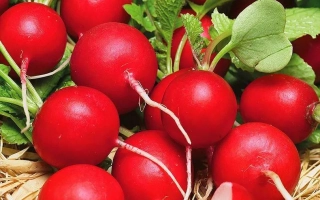
In addition to microgreens, this variety is characterized by early root crop maturity — from 18 to 29 days after germination. The root crops have a round shape with bright purple skin and tender, snow-white pulp, which is juicy and has an excellent taste. The radish is resistant to bolting, allowing year-round cultivation starting from early spring to late autumn. The fruits do not form hollows, weigh about 25-30 grams, and are well-suited for growing in winter greenhouses under lowered temperatures and weak lighting.
Petersburg Purple Radish is rich in phytoncides and essential oils, possessing a natural antimicrobial effect and aiding digestion. Microgreens contain important trace elements such as silicon, zinc, iodine, and calcium, as well as vitamins of groups C and B. Consuming this radish stimulates gastrointestinal tract function, accelerates metabolism, helps prevent diabetes, and aids in weight control due to its low caloric content — only 20 kcal per 100 grams of product. Thus, the Petersburg Purple Radish is not only tasty but also a beneficial product for the daily diet.
In addition to microgreens, this variety is characterized by early root crop maturity — from 18 to 29 days after germination. The root crops have a round shape with bright purple skin and tender, snow-white pulp, which is juicy and has an excellent taste. The radish is resistant to bolting, allowing year-round cultivation starting from early spring to late autumn. The fruits do not form hollows, weigh about 25-30 grams, and are well-suited for growing in winter greenhouses under lowered temperatures and weak lighting.
Petersburg Purple Radish is rich in phytoncides and essential oils, possessing a natural antimicrobial effect and aiding digestion. Microgreens contain important trace elements such as silicon, zinc, iodine, and calcium, as well as vitamins of groups C and B. Consuming this radish stimulates gastrointestinal tract function, accelerates metabolism, helps prevent diabetes, and aids in weight control due to its low caloric content — only 20 kcal per 100 grams of product. Thus, the Petersburg Purple Radish is not only tasty but also a beneficial product for the daily diet.
Crop & resistance
Crop
Specifications hover over for a hint about the specification
| Redis Type | |
|---|---|
|
Growing Period
Growing Period
For autumn-winter cultivation of radish, varieties with low branching and short growing period are preferable, which exhibit strong root growth under low light conditions. |
|
|
Maturation Period
Maturation Period
Vegetation period from emergence to technical maturity 30-50 days. |
18 - 20 days |
|
Root vegetable; weight
Root vegetable; weight
Carrot roots vary in weight from 60-150 g, sometimes 300-500 g. |
25 - 30 grams |
|
Root; shape
Root; shape
Roots can be round, elongated-round, cylindrical, conical. |
|
| Registration year | 2021 |
| Catalog | Catalog → Radish |
| Legal data |
Show · 4
|
| Country | Russia |
Not yet комментариев. Be the first!
Alternatives
Radish seeds · similar varieties





See also
Often considered together with this variety





Recently viewed
Products you’ve viewed on this site
Reviews · 0