


SKU #4105
·
399 views
Quince Zubutlinskaya
Quince
User rating
4 votes100% positive reviews
No ratings yet — be the first.
Assignment
Industrial Processing
Type of Sort
Sort
Usage Group
Universal
Ripening Period
305-319
Store offers · 2 from 2 stores
Prices are updated on loadLoading offers…
Available at: Лучший Сад · Agromir
Aggregator catalog: prices are collected automatically from store websites, normalized by AI and converted at the current exchange rate. Before ordering, confirm the price and availability on the store's website. This block is not indexed by search engines — the data is loaded after the page opens.
About product

Local late-winter variety of quince, a folk selection from Dagestan, originating from the village of Zubutli in the Kazbekovsky district of the Republic of Dagestan. Approved for the North Caucasus region. Widely distributed in the plain and foothill zones of Dagestan. Medium-sized tree; crown shape is high-rounded in young trees, spherical in fruiting stage; fruiting type — on one-year growth…
Assignment
Industrial Processing
Type of Sort
Sort
Usage Group
Universal
Ripening Period
305-319
Description
Local late-winter variety of quince, a folk selection from Dagestan, originating from the village of Zubutli in the Kazbekovsky district of the Republic of Dagestan. Approved for the North Caucasus region. Widely distributed in the plain and foothill zones of Dagestan.
Medium-sized tree; crown shape is high-rounded in young trees, spherical in fruiting stage; fruiting type — on one-year growth, fruiting spur, fruiting branch.
Buds of medium length and thickness, dark brown. Leaves large, surface wrinkled, margins entire, petiole short and thick, stipules absent.
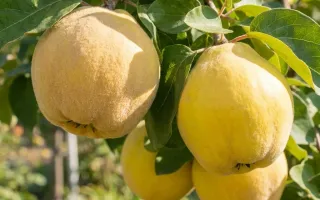
Fruits very large, average weight 350 g, maximum 800 g. Fruit shape round, bluntly ribbed, surface smooth. Skin color golden-yellow, shiny. Absence of bloom and waxy coating; fruits have woolly hairs. Fruit stalk-long, thick; calyx large, closed, often half-open; subcalyx tube medium-sized, usually cup-shaped; seed chambers large, closed; seeds medium, brown; central cavity very large.
Flesh light-yellow, juicy, free of stone cells, pleasant taste, fruits suitable for high-quality canned goods.
The variety is distinguished by rich chemical composition of fruits: dry matter — 15.7%, total sugar — 9.6%, acidity — 1.07%, ascorbic acid — 18.3 mg/100g, pectin substances — 1.1%, tannins — 0.09%.
Fruit bearing starts at 5-6 years, annual fruiting, yield 150-180 centners per hectare. Ripening period late-winter, harvest from November 1 to November 15. Fruit storability and transportability good.
Winter hardiness of trees and fruit wind resistance high. Variety resistant to fungal diseases and pests.
Like Ktyun-zhum, the variety can be propagated by three methods — layering, root suckers, and budding. Rootstock trees grow well, fruit longer, and are more durable.
Advantages of the variety: large fruits with good storability and transportability, high yield, winter hardiness, disease resistance, wind resistance.
Disadvantages of the variety: not very high taste quality of fruits.
The Zubutlinskaya variety is one of the best sources for creating high-yield, large-fruited late-winter quince varieties with good storability, transportability, rich biochemical composition of fruits, high winter hardiness, and disease resistance.
Crop & resistance
Crop
Specifications hover over for a hint about the specification
| Assignment | |
|---|---|
| Type of Sort | |
| Usage Group | |
|
Ripening Period
Ripening Period
It takes 70-100 days until pepper reaches flowering stage, 130-160 days until technical fruit ripeness, and 135-180 days until physiological ripeness. |
305-319 |
| Flavor | |
|
Fruit Color
Fruit Color
The fruit color of tomato varieties is influenced by the combination of skin and flesh color. Some varieties have transparent skin, others — yellow. When combined differently, the fruits can acquire quite diverse colors. The fruit color is affected by pigments (lycopene) and thei... |
|
| Meat Texture Consistency | |
| Height and shape of the tree | |
| Disease Resistance | |
| Cold Resistance | |
| Transportability | |
| Laziness | |
| Features | |
| Catalog | Catalog → Quince |
Not yet комментариев. Be the first!


See also
Often considered together with this variety




Recently viewed
Products you’ve viewed on this site
Reviews · 0