


SKU #4098
·
352 views
Quince Anjerskaya
Quince
Prices in stores
from1.63 €per seedling
pack from 2.17 € per pack
10 offers from 8 stores
Purpose
Processing
Type of Variety
Variety
Usage Group
Wine
Ripening Period
140-146
Your mark
0 votes
0% positive ratings
Store offers · 10 from 8 stores
10 offers in 8 stores — from 1.63 € per seedling.
Available at: Agro-market · biolocus-plant-pro · Biosad · Добродар · Doslidna Stantsiya · Панські Сади · Sadco · Сади на Дачі
Prices are collected automatically from store websites and converted at the current exchange rate. Check the price and availability on the store website before ordering.
Description
French variety, origin unknown. Was regionally selected in the Lower Volga region.
Tree bushy, multi-stemmed (6-7 stems), medium-sized (height 3.5 m, diameter 3.2-3.5 m, crown volume 10.7 m3), with a rounded crown. Bark light-brown in color, flaky surface.
Shoots of medium length and thickness, slightly knotted, olive-brown in color. Internodes of medium length, buds small, narrow-conical, with weak woolly pubescence, strongly pressed. Leaves large, round, light-green, soft, with dense woolly pubescence on the underside of the leaf blade, leaf blade margins smooth. Petiole short, with weak anthocyanin, transitioning to the central vein.
Flower large, solitary, pale-pink in color, pedicel densely hairy, sepals pale-green, lanceolate, toothed with a pattern, abundant glandular hairs along the margins and underside. Petals 5 in number, large, round. Stamens 20-25 in number, light-purple in color, pollen sacs large, pale-yellow, stigma positioned slightly above the pollen sacs, moderately hairy.
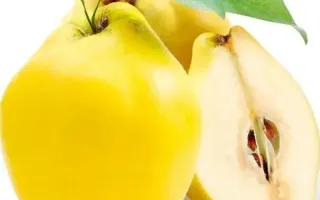
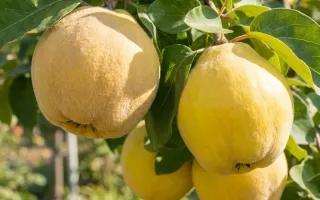
Fruits below average size (average fruit mass 140-150 g), flat-round, ribbed, with moderate pubescence. Color yellow, calyx half-open, medium, sepals medium, lanceolate, toothed with a pattern, abundant glandular hairs along the margins and underside; receptacle deep, narrow, folded, cup shallow, roughened with rust-colored patches emerging from the depression, cup with a swelling. Heart-shaped, medium, symmetrical, axial. Axial cavity wide. Seed chambers closed, bud-like, each containing 9 to 11 elongated, dark-brown seeds.
Flesh yellow in color, dense, coarse-grained consistency, moderate content of stone cells, medium juiciness, sweet-sour with high aroma and good flavor. Chemical composition of fruits: dry matter on average 19.8% (max 22.2%), total sugars — 8.8% (11.6%), titratable acids — 0.86% (1.34%) on fresh weight, sugar-to-acid ratio — 11.8 (28.3), ascorbic acid — 18.5 mg/100g (24.5), polyphenols (catechins) — 188 mg/100g (124-302), flavonols — 48 mg/100g (21-78), total phenolic compounds — 1128 mg/100g (580-1862), pectin substances — 1.29% (0.76-2.25%) on fresh weight.
Period from flowering to fruit harvest — 140-146 days. Length of vegetation period — on average 195 days.
Harvesting period — first half of September, storage duration — up to 90 days. Intended use — for processing. Sensory evaluation of compote — 4.5 points, jam — 4.7 points.
Self-incompatible. Best pollinators: Early Oil, Teplovskaya, Nakhodka.
Tree enters fruiting stage on the 4th-5th year after grafting. Average yield — 39.2 kg/tree or 163 centners/ha. Annual fruiting.
Resistant to skin spot disease during storage, chlorosis, and bacterial diseases.
Advantages of the variety: medium tree size, disease resistance, high technological evaluation.
Disadvantages of the variety: low marketability, uneven fruit size, fruit drop before harvest maturity.
Crop & resistance
Crop
Disease resistance
Specifications
| Purpose | |
|---|---|
| Type of Variety | |
| Usage Group | |
| Ripening Period | 140-146 |
| Fruit Color | |
| Flesh Consistency | |
| Height and shape of the tree | |
| Disease Resistance | |
| Keeping quality | |
| Features | |
| Catalog | Catalog → Quince |
No reviews yet. Be the first to share your experience.





See also
Often considered together with this variety


Recently viewed
Products you’ve viewed on this site
Reviews