


SKU #4122
·
242 views
Amber Krasnodar
Quince
User rating
0 votes0% positive reviews
No ratings yet — be the first.
Assignment
Industrial Processing
Type of Sort
Sort
Usage Group
Universal
Flavor
Sour-sweet
Prices in stores
from4.45 €per seedling
pack from 3.26 € per pack
8 offers from 2 stores
Store offers · 8 from 2 stores
Prices are updated on loadLoading offers…
Available at: Панські Сади · Agromir
Aggregator catalog: prices are collected automatically from store websites, normalized by AI and converted at the current exchange rate. Before ordering, confirm the price and availability on the store's website. This block is not indexed by search engines — the data is loaded after the page opens.
About product

This variety was selected at the Crimean Experimental Station of VIR from local forms of quince. Breeders: T. S. Vasilenko, I. M. Ryadnova. Approved and widely grown in the North Caucasus region.
Medium-sized tree, spherical and densely foliated crown. Main branches diverge from the trunk at an angle close to 90°, slightly curved, thick, bark dark gray with large brown wart-like bumps, givin…
Assignment
Industrial Processing
Type of Sort
Sort
Usage Group
Universal
Flavor
Sour-sweet
Description
This variety was selected at the Crimean Experimental Station of VIR from local forms of quince. Breeders: T. S. Vasilenko, I. M. Ryadnova. Approved and widely grown in the North Caucasus region.
Medium-sized tree, spherical and densely foliated crown. Main branches diverge from the trunk at an angle close to 90°, slightly curved, thick, bark dark gray with large brown wart-like bumps, giving it a brownish appearance. The trunk has the same coloration as the main branches, rough, peeling bark. Fruit set occurs mainly on one-year-old shoots, fruiting branches, and twigs.
Medium-thick, slightly curved, nearly straight, brown, shiny, pubescent shoots at the tips. Numerous, medium-sized, brown, round warts; internodes of medium length. Buds small, brown, conical, pressed. Leaf is equilateral, medium-sized and small, round shape, bright green. Leaf blade smooth, matte, slightly convex, thin, leathery. Pubescence on the underside of the leaf is weak; venation weakly expressed, coarse-netted, uncolored. Leaf apex pointed, tip short, tapering. Leaf base rounded or slightly pointed, leaf blade margins smooth, petiole short, weakly pubescent, strongly anthocyanin-colored. Bracts small.
Flowers solitary, medium-sized, light pink. Sepals thin, lanceolate, sharply curled downward. Petals medium-sized, oval. Filaments pale lavender, anthers yellow; pistils at the same level as anthers and slightly below.
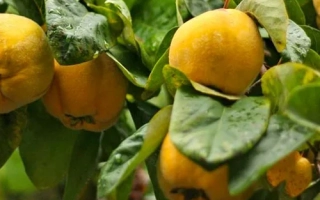
Fruits medium-sized, weighing 150-200 g. Apple-shaped, surface slightly ribbed, oily. Main color bright yellow, orange, amber. Calyx closed, large, sepals tightly closed, small, weakly toothed. Receptacle wide, wrinkled, limited by five bumps; fruiting stem short, thick. Funnel small, wide, smooth, with a protrusion, rust-colored with radial spread. Heart-shaped, medium-sized, slightly asymmetrical, seed chambers closed, walls weakly wrinkled. Seeds large, egg-shaped, light brown, with small amount of sticky substances.
Flesh orange-yellow or bright cream, firm, coarse-grained, few stone cells, juicy, tart-sweet with strong aroma. Fruits contain 14.6% dry matter, 8.5% sugars, 1.16% titratable acids, 25.7 mg/100g ascorbic acid, 108.8 mg/100g raw mass of P-active substances.
Harvesting maturity occurs in the third decade of September. Fruits store up to 90 days, used to produce high-quality processed products (jams, juices, compotes), rated 4-5 points. High transportability.
Trees enter fruiting stage at age 4, fruit annually, average yield 100 centners/ha, maximum 280 centners/ha.
Moderate winter hardiness, high drought resistance. Variety resistant to fungal diseases.
Fruits resistant to under-skin spotting.
Advantages of the variety: early fruiting, high yield, high fruit and processed product quality.
Disadvantages of the variety: fruit size reduction in dry years, insufficient winter hardiness.
Crop & resistance
Crop
Disease resistance
Specifications hover over for a hint about the specification
| Assignment | |
|---|---|
| Type of Sort | |
| Usage Group | |
| Flavor | |
|
Fruit Color
Fruit Color
The fruit color of tomato varieties is influenced by the combination of skin and flesh color. Some varieties have transparent skin, others — yellow. When combined differently, the fruits can acquire quite diverse colors. The fruit color is affected by pigments (lycopene) and thei... |
|
| Meat Texture Consistency | |
| Height and shape of the tree | |
| Disease Resistance | |
| Cold Resistance | |
| Transportability | |
| Laziness | |
| Features | |
| Catalog | Catalog → Quince |
Not yet комментариев. Be the first!






See also
Often considered together with this variety


Recently viewed
Products you’ve viewed on this site
Reviews · 0