


SKU #4110
·
412 views
Ktyun-zhum (Winter Quince)
Quince
User rating
1 vote100% positive reviews
No ratings yet — be the first.
Assignment
Industrial Processing
Type of Sort
Sort
Usage Group
Universal
Flavor
Sour-sweet
About product

A valuable late-winter local quince variety, selected by the people of Southern Dagestan. It is mainly distributed in Southern Dagestan and has been regionally approved in the North Caucasus region.
The tree is vigorous and one of the most vigorous and large-fruited quince varieties in the Caucasus. In its youth, the tree has a narrow-cylindrical crown shape, which becomes broadly round when f…
Assignment
Industrial Processing
Type of Sort
Sort
Usage Group
Universal
Flavor
Sour-sweet
Description
A valuable late-winter local quince variety, selected by the people of Southern Dagestan. It is mainly distributed in Southern Dagestan and has been regionally approved in the North Caucasus region.
The tree is vigorous and one of the most vigorous and large-fruited quince varieties in the Caucasus. In its youth, the tree has a narrow-cylindrical crown shape, which becomes broadly round when fruiting; fruiting occurs on one-year-old shoots, fruiting branches, and fruiting twigs.
Branches are long, thick, dark brown with a greenish tint. Leaves are large, wrinkled, entire, with long and thick petioles and no stipules.
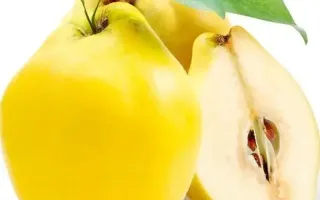
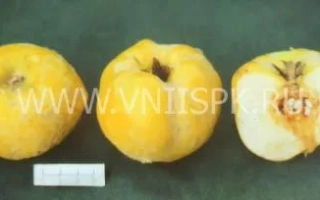
Fruits are medium to large, averaging 250 g, up to 800 g in maximum size, with a high-cylindrical shape, broad-ribbed, smooth surface, and a constriction (narrowing) near the apex. Skin color is golden-yellow; no bloom or waxy coating is present upon harvesting, and the fruits have a woolly pubescence. The pedicel-fruiting twig is long and thick. The calyx is large and closed. The subcalyx tube is small and very narrow or almost absent. Seed chambers are large and closed. Seeds are large, pointed-egg-shaped. The central cavity is large and elongated.
Flesh is pale-yellow, juicy, slightly acidic-sweet, with superior flavor qualities. The fruits contain: dry matter — 14.4%, sugars — 9.1%, acids — 0.86%, ascorbic acid — 23.1 mg/100g, pectin substances — 0.97%, and tannins — 0.16%.
Harvesting period ends in late October; it is a late-winter variety, with consumer maturity occurring one month after harvest. Fruit wind resistance is insufficient. Transportability is good.
Fruits can be stored in ordinary fruit storage facilities until spring. They are also suitable for making high-quality preserves (compote and jam).
Trees begin fruiting at 5-6 years of age, with annual fruiting. Yield: 250-300 centners/ha.
The variety is winter-hardy, resistant to fungal diseases and pests. It propagates well via layering, root suckers, and grafting (bud grafting).
Advantages of the variety: high yield, large fruit size, long storage life, good transportability, rich chemical composition, good canning qualities, and ability to propagate via layering, root suckers, and grafting.
Disadvantages of the variety: inferior flavor quality and insufficient fruit wind resistance.
The Ktyun-zhum variety is the best source for developing high-yielding, large-fruited late-winter quince varieties with long storage life, good transportability, and good canning qualities.
Crop & resistance
Crop
Specifications
| Assignment | |
|---|---|
| Type of Sort | |
| Usage Group | |
| Flavor | |
| Height and shape of the tree | |
| Disease Resistance | |
| Cold Resistance | |
| Transportability | |
| Laziness | |
| Features | |
| Catalog | Catalog → Quince |
Store offers
Prices are updated on loadLoading offers…
Aggregator catalog: prices are collected automatically from store websites, normalized by AI and converted at the current exchange rate. Before ordering, confirm the price and availability on the store's website. This block is not indexed by search engines — the data is loaded after the page opens.
Not yet комментариев. Be the first!


See also
Often considered together with this variety




Recently viewed
Products you’ve viewed on this site
Reviews · 0