


SKU #4246
·
400 views
Nika
Plum
User rating
0 votes0% positive reviews
No ratings yet — be the first.
Type of Sort
Home Drain
Store offers · 3 from 2 stores
Prices are updated on loadLoading offers…
Available at: Все для сада · Agromir
Aggregator catalog: prices are collected automatically from store websites, normalized by AI and converted at the current exchange rate. Before ordering, confirm the price and availability on the store's website. This block is not indexed by search engines — the data is loaded after the page opens.
About product

This variety was developed at the Rossoshskaya Zonal Experimental Station for Horticulture by A.Y. Voronchikhina through pollination of elite seedling 59/28 (Ochakovskaya x Ternosliava No. 1) from the Kuybyshevskaya Experimental Station for Horticulture, using pollen mixtures from selected hybrids 54-13 (Renklod Ternovoy x Renklod Reforma) and 57-46 (Renklod Ulyanichева — open pollination) from t…
Type of Sort
Home Drain
Description
This variety was developed at the Rossoshskaya Zonal Experimental Station for Horticulture by A.Y. Voronchikhina through pollination of elite seedling 59/28 (Ochakovskaya x Ternosliava No. 1) from the Kuybyshevskaya Experimental Station for Horticulture, using pollen mixtures from selected hybrids 54-13 (Renklod Ternovoy x Renklod Reforma) and 57-46 (Renklod Ulyanichева — open pollination) from the Rossoshskaya Zonal Experimental Station for Horticulture. Since 1994, it has been recommended for the Central Chernozem region. It is currently distributed sparingly, primarily in suburban gardens in southern Voronezh and Belgorod regions and northern Rostov Oblast.
The tree is medium- or strongly-growing, reaching 4 meters or more in height at 15 years old; its crown is broadly oval or conical, spreading, of medium density, with moderate leafiness; the bark on the trunk is dark gray or black-gray, strongly rough, with medium or strong longitudinal cracking, and no or weak swaying. Buds are weakly visible, convex, medium or short, rather wide, arranged with medium density. Shoots are usually curved, with rather short internodes, brownish-pink in sunlight and light green in shade, then turn brownish-black with characteristic longitudinal cracking; longitudinal cracks are wide, colored light brown or yellowish-brown; due to this characteristic striped appearance, Nika is easily distinguishable from other varieties; shoot hairs are dense and persist until autumn. Vegetative buds are conical, pointed at the tip, medium-sized, 4-5 mm long; generative buds are much smaller, 1.5-2.5 mm, from broad-conical to nearly egg-shaped; both types are set apart from the shoots. Leaf blade ranges from elongated-oval to elongated-egg-shaped, apex pointed or long-pointed, base rounded to wedge-shaped; 6-10 cm long, 4-6 cm wide on one-year shoots; upper surface green, glossy, hairless, lower surface light gray-green, hairy, especially along veins; margins doubly-toothed, toothiness medium, blade consistency leathery. Petiole 1.5-2 cm long, with 1-2 small glands, purplish-brown anthocyanic coloring, stipules absent. Inflorescence usually contains 2 flowers, rarely 1 or 3; flowers medium-sized, 25-30 mm in diameter, cup-shaped or broad-cup-shaped; petals round or egg-shaped, wrinkled, closely folded; stigma is significantly higher than stamens, stamens 5-7 mm long, stigma with ovary 10-12 mm. Pedicel 15-20 mm long, hairy; calyx tube bell-shaped, hairy, calyx lobes reverse-egg-shaped or round-oval, concave, hairy, slightly curled, significantly shorter than the calyx, calyx 7-8 mm long, calyx lobes 4-5 mm; ovary hairless.
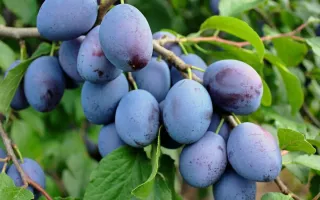
Fruits average 38.5 g in mass, 46 mm in height, 36 mm in width, 37 mm in thickness; at low yields, mass reaches 50-60 g; elongated-oval or oval, asymmetrical relative to the ventral suture, practically not flattened on sides, apex rounded with a small pit in the center, base oval, sometimes slightly elongated into a neck, cavity very narrow and shallow, ventral suture poorly developed, does not crack; fruit shape typical of Hungarian varieties. Main skin color is green, covering color dark-violet, turning brown-violet in shade, covering the entire fruit at full ripeness; fruits hairless, densely covered with a bluish waxy coating. Flesh is yellow-green, becoming brownish-yellow at full ripeness, dense, soft and juicy upon overripening. Taste sweet with slight acidity and mild bitterness, tasting score 4.3 points. Biochemical composition of fruits: 14.6% dry soluble solids; 8.9% sugars, 1.3% titratable acids, 0.6% pectin substances, 9.0 mg/100g ascorbic acid. Peduncle very long, 22-28 mm, 1.5-2 mm thick. Pit average mass 1.4 g, constituting 3.6% of fruit mass, elongated-oval, 22-27 mm long, 16-17 mm wide, apex narrowly rounded, base elongated or strongly elongated, dorsal suture narrowly open, ventral suture narrow with weak central ridge, lateral ridges weakly visible, surface finely pitted; pit lies in a large cavity, well separated from flesh.
Primary use of fruits is fresh consumption. They also yield good juice with flesh, jam, preserves, but they sour in compotes. Ripening occurs in mid-season, in southern Central Chernozem region in mid-August.
Flowering occurs in mid-season. The variety is self-sterile, and in certain years, when weather during flowering is poor, hindering insect flight, it leads to significant yield reduction. Good pollinators are Hungarian Donetsky, Hungarian Donetsky Early, Renklod Soviet.
Trees grafted onto plum seedlings enter fruiting at 4-5 years, with good early fruiting. Average yield over the first 4 years of commercial fruiting was 17.1 kg/tree versus 13.9 kg/tree for the control variety 'Record'. During full fruiting, average yield over 7 years was 22.7 kg/tree (versus 22.4 kg/tree for 'Record'). In the most favorable years, average yield reached 40-45 kg/tree, individual trees produced up to 70 kg of fruit.
Winter hardiness of trees in southern Central Chernozem region is good. Average degree of freezing even in the most unfavorable winters, including the winter of 1986/87 with an absolute minimum of 36.4°, did not exceed 1.4 points; the control variety 'Record' froze to 2.5 points in that winter. Flower buds are more sensitive to low winter temperatures: in the winter of 1978/79 with an absolute minimum of -32.2°, 97.7% of flower buds died (versus 98.6% for 'Record'), and in the winter of 1986/87, mortality was 54.0% (versus 50.4% for 'Record').
Variety Nika shows high resistance to main fungal diseases. No moniliosis or clasterosporiosis has been observed over all observation years. The variety is also resistant to polystigma, and the degree of infection even in epidemic years did not exceed 2 points.
Advantages of the variety: large, attractive fruits with good consumer qualities, good winter hardiness in southern Central Chernozem region.
Disadvantages of the variety: not always regular yield.
Video · 4 videos
Suggest a video →Crop & resistance
Crop
Specifications
| Type of Sort | |
|---|---|
| Catalog | Catalog → Plum |
Not yet комментариев. Be the first!
Alternatives
Plum saplings · similar varieties




See also
Often considered together with this variety


Recently viewed
Products you’ve viewed on this site
Reviews · 0