


SKU #4270
·
420 views
Round Early Fruit
Plum
User rating
0 votes0% positive reviews
No ratings yet — be the first.
Type of Sort
Home Drain
Store offers · 1 from 1 stores
Prices are updated on loadLoading offers…
Available at: Сади Буковини
Aggregator catalog: prices are collected automatically from store websites, normalized by AI and converted at the current exchange rate. Before ordering, confirm the price and availability on the store's website. This block is not indexed by search engines — the data is loaded after the page opens.
About product

A variety of folk selection. Selected from the collection at Pavlovsk Experimental Station of VIR (Pavlovsk, Leningrad Region). Introduced into the State Register in 1959 for the North-West region. Medium-sized tree, 2.5-3 m tall, with a broad, moderately dense, well-leaved crown. Bark on the trunk is gray-brown and slightly rough. Branches are thin, branching at an angle of 30-40° to the trunk.…
Type of Sort
Home Drain
Description
A variety of folk selection. Selected from the collection at Pavlovsk Experimental Station of VIR (Pavlovsk, Leningrad Region). Introduced into the State Register in 1959 for the North-West region.
Medium-sized tree, 2.5-3 m tall, with a broad, moderately dense, well-leaved crown. Bark on the trunk is gray-brown and slightly rough. Branches are thin, branching at an angle of 30-40° to the trunk. One-year-old shoots are slightly curved, medium-thick, reddish-purple on the sun-exposed side. Leaf blade is round-oval, with a pointed apex and a heart-shaped base, small (7 x 3 cm), dark green, slightly concave near the base, with a wavy margin toward the apex. Texture is leathery, medium-thick, glossy surface, without hairs on top and rarely slightly hairy on the underside. Margins are coarsely doubly toothed. Petiole 9-13 mm, with anthocyanin coloration on top. Stipules are one, rarely two, small, sessile, yellow-green. Bracts are small, awl-shaped, light green. Flowers are medium-sized, bloom in the second half of May. Flowering lasts 8-10 days. Flowers and fruits form on shoots from the previous year. Growth shoots are located at the periphery of the crown.
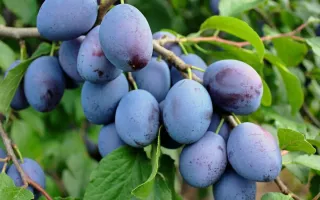
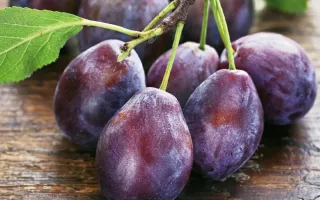
Fruits are round, weighing 8-12 g, dark blue with a purplish tinge and a slight blue bloom, with small dots over the entire fruit surface. Flesh is yellow, finely textured, sweet-sour, juicy, good quality. Skin is relatively thick and tough, does not separate from the flesh or separates poorly. Pit is small, oval, separates easily from the flesh. Fruits contain 13.8-15.6% dry matter, 8.7-9.9% sugars (including up to 2.9% sucrose), 1.45-1.51% acids, 17.6-20.8 mg/100g vitamin C. Fruits are consumed fresh and processed into jams, jellies, and compotes.
Trees are self-sterile. Best pollinator — Red Early Fruit. Trees begin fruiting 3-4 years after planting in the orchard. Fruits ripen in the second half of August. Fruits are produced annually. Yield is 10-15 kg per tree, up to 25 kg per tree in favorable years. Fruits do not crack, but drop off when ripe.
Plants are cold-tolerant, but in severe winters suffer significant damage (up to 4-5 degrees). Affected by aphids, leafrollers, fruit borers, "carpet scales", "milky sheen", and fruit rot (in certain years severely).
Advantages of the variety: early fruiting, early fruit ripening, good yield, good fruit quality, good pit separation, versatile fruit use.
Disadvantages of the variety: significant winter damage in severe winters, insufficient disease and pest resistance, mandatory presence of pollinator varieties, poor skin separation from flesh.
Crop & resistance
Crop
Specifications
| Type of Sort | |
|---|---|
| Catalog | Catalog → Plum |
Not yet комментариев. Be the first!
Alternatives
Plum saplings · similar varieties



See also
Often considered together with this variety




Recently viewed
Products you’ve viewed on this site
Reviews · 0