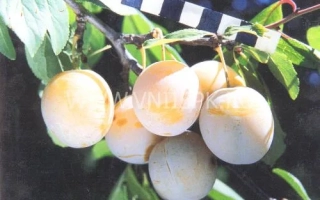
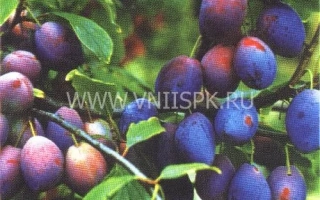
This variety was obtained by crossing varieties Evrazia 21 and Renkloch Altana at the All-Russian Research Institute of Genetics and Breeding of Fruit Plants named after I.V. Michurin. Author: G.A. Kursakov. Introduced into the State Register since 2000 for the Central Chernozem region.
Medium-growing tree, with a round crown of medium density and leafiness. Branches of medium thickness, medium length, straight, brownish-brown color. Buds medium-sized, dark brown, conical-rounded shape. Leaf medium-sized, broadly oval, short-pointed, dark green, smooth, matte. Leaf blade curved downward. Absence of pubescence. Leaf margin serrated. Petioles short, thick, weakly pigmented. Stigmas medium-sized, yellow, round, two in number. Flowers in pairs per inflorescence, size above average, pistil length approximately twice the length of stamen filaments. Calyx bell-shaped.
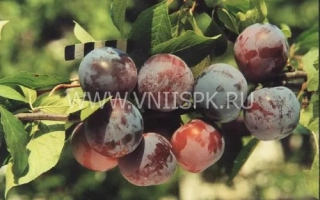
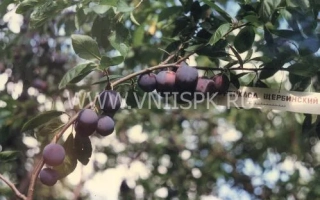
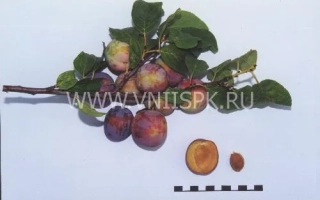
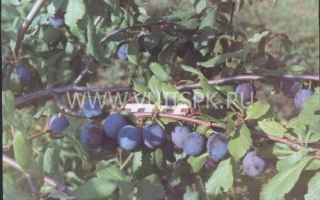
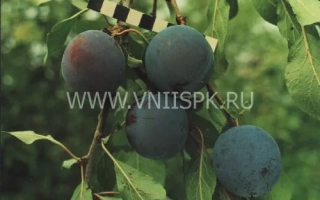
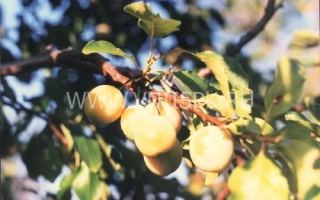
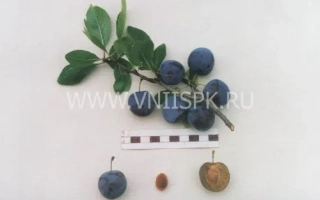
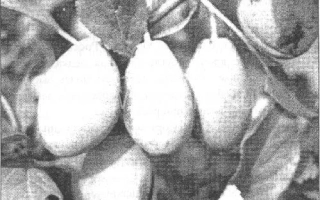
Fruits of medium or above-average size have an average weight of 26.4 g, maximum 29.0 g. Fruit shape is round, color purple-red. Numerous lenticels, brown, clearly visible. Flesh orange, tender, juicy. Juice colorless. Taste character sour-sweet (4.2 points). Pedicel of medium length and thickness. Stone is inversely egg-shaped, medium-sized, pointed, easily separates from the flesh. Biochemical composition: dry matter — 14.6%, sugars — 9.8%, acids — 1.7 mg/100g, P-active catechins — 156 mg/100g, ascorbic acid — 10.1 mg/100g. Variety intended for table and processing use. Good transportability of fruits.
Partially self-fertile. Flowering period medium, fruit ripening early-medium, slightly later than Renkloch Kolhoznogo. Trees enter fruiting by the 3rd year after planting in the orchard. Annual yield.
Advantages: early fruiting, annual yield, winter hardiness, and good fruit qualities suitable for fresh consumption and processing, good fruit transportability.
Disadvantages: none identified.