


SKU #4264
·
605 views
Rossoshansky Large-fruited
Plum
User rating
0 votes0% positive reviews
No ratings yet — be the first.
Type of Sort
Home Drain
Store offers · 1 from 1 stores
Prices are updated on loadLoading offers…
Available at: Саженцы и семена
Aggregator catalog: prices are collected automatically from store websites, normalized by AI and converted at the current exchange rate. Before ordering, confirm the price and availability on the store's website. This block is not indexed by search engines — the data is loaded after the page opens.
About product

Obtained at the Rossoshansky Zonal Experimental Station for Horticulture from the cross of varieties 'Persikovaya Michurin' and 'Rannaya Siniy' (Tsar). In 1986, the variety was accepted for state variety testing in the Central Chernozem region of Russia. It is currently distributed only weakly, mainly in private gardens in Voronezh and Belgorod regions. The tree is weak-growing; at 15 years of ag…
Type of Sort
Home Drain
Description
Obtained at the Rossoshansky Zonal Experimental Station for Horticulture from the cross of varieties 'Persikovaya Michurin' and 'Rannaya Siniy' (Tsar). In 1986, the variety was accepted for state variety testing in the Central Chernozem region of Russia. It is currently distributed only weakly, mainly in private gardens in Voronezh and Belgorod regions.
The tree is weak-growing; at 15 years of age, its height does not exceed 3 m. The crown is bushy, spreading, moderately sparse, with weak or moderate leafiness. The bark on the trunk is gray-brown, smooth, with strong longitudinal cracking; the trunk is not swollen. The buds are sunken, short, but wide, densely arranged. The shoots are straight or occasionally slightly curved; internodes are long. In young age, they are brownish-magenta in sunlight and light-green with brown spots in shade, later becoming brown; the pubescence is very short but fairly dense. Vegetative buds are conical with a pointed apex, large — 4-5 mm long, pressed; generative buds are broad-conical with a pointed apex, smaller — 2.5-3 mm, spaced or even protruding. The leaf blade is round, with a rounded or blunted apex and a rounded base, 9-10 cm long and 8-9 cm wide on one-year-old shoots, wrinkled, often convex or spirally curved along the central vein; upper surface green, glabrous, slightly glossy; lower surface light-green, sparsely pubescent, with double-toothed margins, fine serrations, elastic consistency. The petiole is 20-25 mm long with 1-2 small light glands, light-green, occasionally with very slight brownish-red covering coloration; stipules absent. In the inflorescence, 1-2 flowers; flowers small, 20-25 mm in diameter, broadly campanulate or broadly cup-shaped, occasionally flat; petals obovate, usually not closed; stigma slightly elevated above stamens, stamens 7-11 mm long, stigma with ovary about 15 mm. Pedicel 23-28 mm long, weakly pubescent; tube of the calyx short-campanulate, about 4 mm long, light-green, calyx lobes about 4 mm long, oval or lanceolate, concave, slightly inflated, almost equal in length to the tube, entire margins; ovary glabrous.
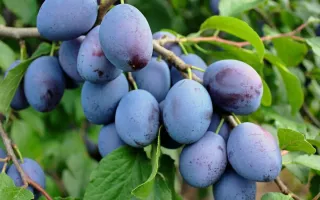
Fruits average weight 36.6 g, height 42 mm, width 41 mm, thickness 44 mm; oval to round, well-shaped, slightly or moderately flattened on sides; apex rounded, base flat or slightly rounded, pit very narrow and small, ventral suture small and wide but clearly expressed, does not crack. Main skin color is light green-yellow, covering color dark-purple on sunny side and red-purple or brown-red with translucent spots of main green-yellow coloration in shade, covering color occupies more than 50% of fruit surface; fruits glabrous, covered in medium degree with bluish waxy bloom. Flesh amber-colored, medium density, juicy, sweet with slight acidity, good flavor with taste rating of 4.5 points. Biochemical composition of fruits: 14.6% dry soluble solids; 9.5% sugars, 1.3% titratable acids, 0.7% pectic substances, 11.6 mg/100g ascorbic acid. Pedicel very long, 20-25 mm, thin 1.0-1.5 mm. Stone large, average weight 1.8 g, constituting 4.9% of fruit weight, broadly oval, flat, 25-27 mm long, 20-25 mm wide, apex broadly rounded, base from narrowly rounded to elongated, dorsal suture widely open along entire length, ventral suture medium, lateral ribs strongly protrude and clearly expressed, surface moderately pitted and bumpy; stone lies in large cavity, well separated from flesh.
Fruits are suitable for fresh consumption as well as various processing methods — juice with pulp, jam, preserves. Compote from Rossoshansky large-fruited fruits has high quality, fruits retain shape well, do not become sour, overall compote rating is 4.5 points. Fruits are also suitable for preparing large high-quality black plums with overall rating of 4.8 points.
Ripening occurs in medium term, in southern Central Chernozem region in mid-August. Flowering occurs in medium term, variety is self-sterile, best pollinators — Soviet Renklod, Nagrada, Voskhod.
Trees grafted onto seedling plums enter fruiting at 4-5 years, high early fruiting. Average yield over first 4 years of commercial fruiting was 21.9 kg/tree vs. 13.9 kg for control variety 'Record'. At 6 years after planting, average yield per tree was 63.6 kg. During full fruiting, average yield over 3 years was 29.1 kg/tree (vs. 25.8 kg/tree for 'Record'). Variety tends to overfruit and exhibit alternate bearing.
Winter hardiness of trees in southern Central Chernozem region is good. Average degree of frost damage to trees even in unfavorable winter of 1975/76 with temperatures down to -34° did not exceed 1.0 point. Flower buds are more sensitive to low winter temperatures: in severe winter of 1978/79 with absolute minimum -32.2°, 95.3% flower buds died, vs. 98.6% for control variety 'Record'.
Rossoshansky large-fruited is slightly (up to 1.0 point) affected by clasterosporiosis and up to 0.3 point by moniliosis. Unfortunately, this variety is completely susceptible to polystigmia (red spot disease), heavily affected by 5 points in epidemic years. Trees shed all leaves, fruits underdevelop, drop off. In subsequent winter, trees suffer severe frost damage. Therefore, protective measures against polystigmia are necessary during cultivation.
Advantages of the variety: large, attractive fruits with good consumer and high technological qualities, high yield.
Disadvantages of the variety: low resistance to polystigmia.
Video · 1 video
Suggest a video →Crop & resistance
Crop
Specifications
| Type of Sort | |
|---|---|
| Catalog | Catalog → Plum |
Not yet комментариев. Be the first!
Alternatives
Plum saplings · similar varieties



See also
Often considered together with this variety


Recently viewed
Products you’ve viewed on this site
Reviews · 0