


SKU #4260
·
530 views
Soviet Renclod
Plum
User rating
0 votes0% positive reviews
No ratings yet — be the first.
Type of Sort
Home Drain
Store offers · 10 from 6 stores
Prices are updated on loadLoading offers…
Available at: AgronomVIP · ВіоСад · Sadovnik-sam · Интернет магазин садовых растений Все Сорта · Agromir · Sadovaya Kollektsiya · Yurievsad
Aggregator catalog: prices are collected automatically from store websites, normalized by AI and converted at the current exchange rate. Before ordering, confirm the price and availability on the store's website. This block is not indexed by search engines — the data is loaded after the page opens.
About product

Obtained at the Rossoshenskaya Zonal Experimental Station for Horticulture from crossing the varieties Renclod Ulyanischeva and Record. In 1986, the variety was approved for the Central Chernozem region. It is widely popular among the population of Voronezh, Belgorod, and Rostov regions and is often found in commercial and private gardens. The tree is weak-growing, reaching a height of no more th…
Type of Sort
Home Drain
Description
Obtained at the Rossoshenskaya Zonal Experimental Station for Horticulture from crossing the varieties Renclod Ulyanischeva and Record. In 1986, the variety was approved for the Central Chernozem region. It is widely popular among the population of Voronezh, Belgorod, and Rostov regions and is often found in commercial and private gardens.
The tree is weak-growing, reaching a height of no more than 3 m at 15 years of age, with a broad-pyramidal or broom-like crown, sparse, with rather weak leafiness. By crown type, it resembles the Renclod Altana variety, whose maternal variety is Renclod Ulyanischeva. The bark on the trunk is gray-brown, smooth, with strong longitudinal cracking; the trunk is not twisted. Buds are convex, medium in length and width, densely arranged. Shoots are straight, with relatively short internodes, purplish-brown, densely hairy. Vegetative buds are conical, with a pointed apex, large, 5-6 mm long; generative buds are smaller — 2.5-3 mm, also conical with a pointed apex; both types are set apart from the shoots. Leaf blade is oval or elongated-oval, with a pointed apex and rounded base, 7-8 cm long, 4-5 cm wide on one-year shoots; on spurs, it varies significantly in size: length 6-12 cm, width 3-6 cm, and shape — in addition to oval and elongated-oval, it also occurs inversely-egg-shaped and elongated-inversely-egg-shaped, apex may be bluntly pointed, base wedge-shaped or narrowly wedge-shaped. Leaf blade is dark green on top, glossy, bare, light green underneath, hairy on the entire surface; flat, at the base of one-year shoots, slightly convex along the central vein, with doubly serrated edges, medium serration, leathery consistency. Petiole 15-20 mm long, with two medium-sized glands, dirty-bordeaux, stipules absent.
In inflorescence, usually 2 flowers; flowers small, 20-25 mm in diameter; petals round, white, slightly wrinkled, closed; pistil is level with stamens, stamens 6-9 mm long, pistil with ovary 10-12 mm long. Pedicel short, 10-12 mm, densely hairy; calyx tube bell-shaped, 3-4 mm long, light green; sepals acuminate-lanceolate, about 3 mm long, inflated, concave, hairy inside, outside, like calyx tube, bare, ovary bare.
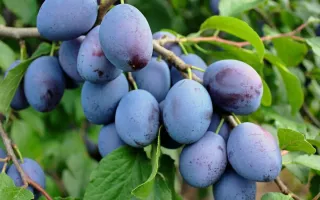
Fruits are large, average weight 41.5 g, height 43 mm, width 43 mm, thickness 43 mm; the largest reach 80 g, round, regular, practically not flattened on the sides; apex rounded, base slightly rounded or flat, pit small and narrow, ventral suture small and wide, but clearly expressed, does not crack. Main skin color is green, covering dark-violet, transitioning to brown-violet in shade, covering almost the entire fruit at full ripening; fruits are bare, densely covered with a bluish waxy coating. Flesh is dull brown-yellow, dense, becomes soft and juicy upon overripening. Taste is sweet with a slight acidity, pleasant, with a tasting score of 4.3-4.5 points. Chemical composition of fruits: 14.1% soluble solids; 9.2% sugars, 1.7% titratable acids, 0.3% pectic substances, 7.7 mg/100g ascorbic acid. Peduncle medium length, 12-15 mm, thickness 1.5-2 mm. Stone average weight 1.2 g, which constitutes 2.9% of fruit mass, oval or broadly oval, 23 mm long and 17 mm wide, apex broadly rounded, base broadly rounded, slightly sloped, dorsal suture moderately open along the entire length, ventral suture narrow, with medium expression of central ridge, lateral ridges clearly visible, surface smooth; stone lies in a large cavity, well separated from flesh.
Main use of fruits is for fresh consumption. They also yield good juice with flesh, but are poorly suitable for making compotes, as they become sour. Fruits ripen in early-mid season, in southern Central Chernozem by the end of the first to beginning of the second decade of August.
Flowering occurs in mid-season; the variety is self-fertile. Trees grafted onto plum seedlings enter fruiting at 4-5 years, with high early fruiting. Average yield over the first 4 years of fruiting was 9.7 kg per tree compared to 3.8 kg for the control variety Record. During full fruiting, average yield was 33.6 kg/tree (versus 18.7 kg/tree for Record). In the most favorable years, average yield reached 37-40 kg/tree, individual trees yielded 50-60 kg of fruit.
Winter hardiness of the tree in southern Central Chernozem is good. Average degree of freezing even in the most unfavorable winters with absolute minimum of -34° did not exceed 2.0 points. Flower buds also show high resistance: during severe winter 1975-76 with absolute minimum of -34°, they were practically unaffected, with mortality of 1.6%.
Soviet Renclod variety is moderately, up to 2 points, affected by clasterosporiosis in years favorable for disease development and in the absence of control measures. It is highly resistant to moniliosis, with no recorded infections throughout the observation period. Significantly, up to 3-4 points, affected by polystigmia in epidemic years.
Advantages of the variety: high consumer quality of fruits, good winter hardiness, high and regular yield.
Disadvantages of the variety: insufficient resistance to polystigmia, unsuitability of fruits for compotes.
Crop & resistance
Crop
Specifications
| Type of Sort | |
|---|---|
| Catalog | Catalog → Plum |
Not yet комментариев. Be the first!
Alternatives
Plum saplings · similar varieties




See also
Often considered together with this variety


Recently viewed
Products you’ve viewed on this site
Reviews · 0