


SKU #4269
·
488 views
Red Early
Plum
User rating
0 votes0% positive reviews
No ratings yet — be the first.
Type of Sort
Home Drain
Prices in stores
from3.34 €per seedling
pack from 6.45 € per pack
18 offers from 3 stores
Store offers · 18 from 3 stores
Prices are updated on loadLoading offers…
Available at: AgronomVIP · Интернет магазин садовых растений Все Сорта · Agromir
Aggregator catalog: prices are collected automatically from store websites, normalized by AI and converted at the current exchange rate. Before ordering, confirm the price and availability on the store's website. This block is not indexed by search engines — the data is loaded after the page opens.
About product

Russian variety of folk selection, presumably seedling of Prunus cerasifera. In the VIR collection since 1926 (k-4022). Obtained from the former nursery of Regel and Kesselring. Introduced to the State Register in 1947 for the North-Western region. Medium-sized tree, up to 3.5 m tall, with a bushy (oval-spherical) shape up to 3-3.5 m wide. Stem light gray or light brown, smooth or slightly rough.…
Type of Sort
Home Drain
Description
Russian variety of folk selection, presumably seedling of Prunus cerasifera. In the VIR collection since 1926 (k-4022). Obtained from the former nursery of Regel and Kesselring. Introduced to the State Register in 1947 for the North-Western region.
Medium-sized tree, up to 3.5 m tall, with a bushy (oval-spherical) shape up to 3-3.5 m wide. Stem light gray or light brown, smooth or slightly rough. Main branches diverge from the trunk at an angle of 30-50°, fairly upright. Bark gray-brown, smooth or slightly rough, longitudinally non-cracking. Shoots slightly curved, greenish-brown, up to 30-40 cm long, internodes 2.5-4 cm, glabrous. Buds medium-sized, slightly pressed or slightly lagging behind shoots, brownish, 1-2-3 per node. Leaves elongated-ovate, slightly concave, medium-sized (7-9 cm long and 4-5 cm wide), green, glossy, medium thickness, glabrous above, slightly hairy along central and lateral veins below; leaf margin single-toothed, apex acuminate, base cuneate. Petiole 17-19 mm long, green with anthocyanin and 1-2 glands, stipules shield-shaped, 7-9 mm. Flowers medium-open (type 2), petals broadly oval, corolla diameter 24-26 mm, stamen number 23-25, stigma higher than anthers by 2-3 mm, ovary oval, glabrous, calyx cup-shaped or bell-shaped, pedicel 17-22 mm, glabrous. Flowering and fruiting are mainly concentrated on two-year and multi-year wood (second type).
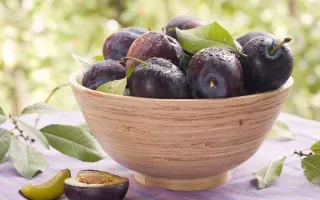
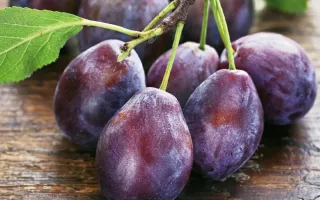
Fruits oval or egg-shaped, up to 15-20 g, 35 mm long, 30 mm wide, and 28 mm thick. Main color pink-red, covering layer magenta-violet, covering most of the fruit. No hairs. Waxy coating bluish-gray, medium. Fruits are asymmetrical. Apex slightly acuminate, slightly curved, base rounded, pit of medium depth, ventral suture moderately developed. Flesh yellow, darkens moderately in air, granular-fibrous, medium density and juiciness. Skin thin, easily peels. Pedicel 17-22 mm. Stone elongated-oval (elongated), with a pointed, slightly curved cone, medium size (24 x 14 x 9 mm, weight 1-1.3 g), constitutes 5-6% of fruit mass, rough, easily separates from flesh.
Fruits have satisfactory taste, slightly acidic-sweet, slightly aromatic, contain 8.5% sugars, 13.6% dry matter, 2.1% acids, 1.08% pectin substances, 0.16% tannin and coloring substances, 8.4 mg/100g ascorbic acid. Fruits ripen unevenly, drop off at ripening. Used fresh and for processing: in canning, they produce low-quality products. In cool storage, fruits can be stored up to 25 days.
Flowers in late May. Fruits ripen in late August — early September (depending on growing zone). Seedling plants enter fruiting at 6-7 years, grafted ones — at 3-4 years after planting in the garden. Lifespan — up to 20-25 years.
Partially self-fertile. Good pollinators include Moscow Hungarian, Ochakovskaya Black, Nikolskaya White, Renklod Kolkhozny, Pulkovskaya Hungarian, Ozyemka White, Renklod Reforma. In favorable years, fruit yield per tree is 25-40 kg. Fruits annually.
Trees are cold-resistant — withstand temperatures down to 35-38°C. Flower buds are less resistant to cold, especially in the second half of winter. Plants are fairly hardy, but grow poorly and fruit poorly on heavy, waterlogged soils. Propagated by budding and root suckers. Plants are slightly affected by diseases and pests (the most damage is caused by aphids).
The variety is widely used in breeding as maternal and paternal forms. More than 30 new varieties have been developed based on it, including: Northern Hungarian, Dubovchanka, Volga Krasavitsa, Mirnaya, Renklod Tambovsky, Iskra, Memory of Timiryazev, Severyanka, Record, etc.
Advantages of the variety: good cold resistance, hardiness, good adaptability, decorative oval-spherical crown, early fruiting, good annual yield, easy stone separation from flesh, relatively long lifespan, low susceptibility to diseases and pests, ability to propagate by root suckers.
Disadvantages of the variety: uneven ripening and fruit drop, low quality of fresh fruits and their processed products, need for pollinizer varieties.
Video · 3 videos
Suggest a video →Crop & resistance
Crop
Specifications
| Type of Sort | |
|---|---|
| Catalog | Catalog → Plum |
Not yet комментариев. Be the first!
Alternatives
Plum saplings · similar varieties


See also
Often considered together with this variety




Recently viewed
Products you’ve viewed on this site
Reviews · 0