


SKU #3705
·
1 343 views
Yakovleva Pear
Pear
User rating
2 votes50% positive reviews
No ratings yet — be the first.
Type of Sort
Autumn variety of pear
Store offers · 4 from 4 stores
Prices are updated on loadLoading offers…
Available at: 1sad · AgronomVIP · Sadovnik-sam · Agromir
Aggregator catalog: prices are collected automatically from store websites, normalized by AI and converted at the current exchange rate. Before ordering, confirm the price and availability on the store's website. This block is not indexed by search engines — the data is loaded after the page opens.
About product

Early-autumn variety obtained by scientists from the All-Russian Scientific Research Institute of Genetics and Selection of Fruit Crops named after I. V. Michurin and Michurin Agricultural University: P. N. Yakovlev, S. P. Yakovlev, Y. S. Nesterov, R. M. Korsikova, by crossing the variety 'Tema' with the French variety 'Olivier de Serr'. Widely cultivated, propagated by nurseries. Approved for Ce…
Type of Sort
Autumn variety of pear
Description
Early-autumn variety obtained by scientists from the All-Russian Scientific Research Institute of Genetics and Selection of Fruit Crops named after I. V. Michurin and Michurin Agricultural University: P. N. Yakovlev, S. P. Yakovlev, Y. S. Nesterov, R. M. Korsikova, by crossing the variety 'Tema' with the French variety 'Olivier de Serr'. Widely cultivated, propagated by nurseries. Approved for Central, Central Chernozem, and Volga regions.
Tree is small, fast-growing, medium-density, with a rounded crown. Main branches emerge at nearly straight angles, forming numerous branched buds with age. Bark on the trunk and main branches is gray and peeling. Distinguished by high bud break and vigorous shoot formation, plants branch on the second field of the nursery. Predominant fruit types are simple and complex buds.
Shoots are medium-thick, light-brown, curved, often with thorns, few stipules. Buds are bent, conical, smooth, with very large axillary buds. Leaves are medium-sized, inversely egg-shaped, green, leathery, apex curled, blade slightly curved, margin serrated, petiole long, stipules medium, lanceolate.
Flowers are white, 4-6 per inflorescence, dish-shaped, petals separate, margin smooth, stigmas at the level of stamens, not double.
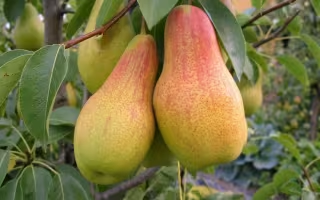
Fruits are medium-sized, uneven in heavy fruiting, broad-pear-shaped, surface smooth. Skin glossy. Color at harvest: main light-yellow, covering as a slight blush on the lower part of the fruit. At consumer ripeness: main golden-yellow, covering orange on the lower part of the fruit, few lenticels. Peduncle long, curved, medium-thick. Nectary small, medium, calyx half-open, plate small, narrow, slightly ribbed. Heart medium, chambers closed, medium, subcalyx tube medium, bowl-shaped.
Flesh is creamy, juicy, sweet, semi-oily, without bitterness, with small granules near the seed cavity. Biochemical composition of fruit: sugars — 12.2%, acidity — 0.25%, ascorbic acid — 9 mg/100g, catechins — 30.2 mg/100g. Also contains significant amounts of arbutin.
Fruits are versatile, produce high-quality processed products — jam, compote.
Fruits remain firmly attached to the tree, well transportable.
Trees begin fruiting in 3-4 years after planting in orchards. Yield increases rapidly: 7-year-old trees produced over 20 kg per tree, and in full fruiting — over 220 centners per hectare. Small tree size allows for denser planting, up to 6x4 meters on seedling rootstock.
Characterized by high winter hardiness; under extreme winter conditions, freezing does not exceed 1.5-2 degrees. However, drought resistance is insufficient, and irrigation results in higher commercial and taste qualities of fruit. Fruits and leaves are not affected by scab, and exhibit high self-fertility.
Advantages of the variety: small trees, early fruiting, high winter hardiness, self-fertility, resistance to scab.
Disadvantages of the variety: some unevenness in fruit size with age and heavy fruiting, presence of stone cells.
Used in breeding to obtain varieties that are low-growing, highly winter-hardy, and disease-resistant.
Video · 9 videos
Suggest a video →Crop & resistance
Crop
Disease resistance
Specifications
| Type of Sort | |
|---|---|
| Catalog | Catalog → Pear |
Not yet комментариев. Be the first!
Alternatives
Pear saplings · similar varieties


See also
Often considered together with this variety


Recently viewed
Products you’ve viewed on this site
Reviews · 0