


SKU #3690
·
1 205 views
Pear Noyabrskaya
Pear
Prices in stores
from4.1 €per seedling
pack from 0.38 € per pack
24 offers from 24 stores
Type of Variety
Autumn variety of pear
Your mark
2 votes
50% positive ratings
Store offers · 24 from 24 stores
24 offers in 24 stores — from 4.1 € per seedling.
Available at: 1sad · AgronomVIP · alexgardenhouse-com-ua · alexgreenmarket-site · biolocus-plant-pro · Biosad · Экосад · Florium · Грінмарт · lemsad-com-ua · Летичев-Сад · Литинсад · moscow-garden24-ru · plodovyimir-ru · Profisad · Sadokshop
Prices are collected automatically from store websites and converted at the current exchange rate. Check the price and availability on the store website before ordering.
Description
Autumn variety developed at the Far Eastern Research Institute of Agriculture by A. V. Bolonyaev in 1950 from crossing Ussuri pear with 'Zimnaya Dekanka'. Approved for the Far Eastern region. Cultivated in the southern part of the Khabarovsk Krai and throughout the Primorsky Krai. Here it is relatively winter-hardy when grown on elevated terrain. In the coastal zone of the Primorsky Krai, it is winter-hardy on any relief forms. Also found in suburban and collective orchards in the Amur region in the form of a bush.
Tree is vigorous, with a round-pyramidal shape. Main branches branch off at right angles and are well-branched. Fruit clusters form on two- to three-year-old wood as shortened twigs and simple rings.
Shoots are relatively thick, slightly curved, greenish-bordeaux. Leaves are medium-sized, oval-elongated, with a dense blade and finely serrated or nearly entire margins. Upper surface is dark green, lower surface is pale green without hairs.
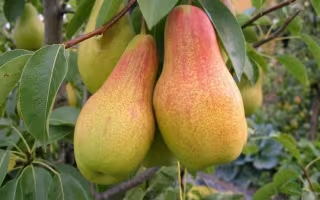
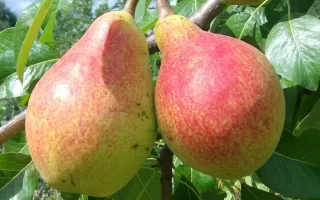
Fruits are small (average weight 64 g, maximum 74 g), egg-shaped, ribbed, slightly asymmetrical, with deep longitudinal grooves, the fruit divided into several unequal segments. Base is blunt, as if cut, uneven. Main color is greenish-yellow, covered with a bordeaux blush. Numerous small, light-brown lenticels. Pit is narrow and shallow. Stem is slightly curved, thick, medium length and thickness, dark-brown. Upper base is slightly sloped, uneven, with a small depression. Calyx is small and narrow. Calyx lobes are narrow, sparse, directed sideways.
Flesh is white, juicy, slightly oily, with a pleasant slightly acidic-sweet flavor and strong aroma. Flavor-wise, it is a good table variety.
Fruits contain total sugars — 10.8%, titratable acids — 0.9%, tannins — 0.5%, pectin substances — 0.4%.
Fruits ripen at the end of September, become suitable for consumption after one month, and can be stored until the end of December. In frozen form, they can be stored throughout winter, and after thawing, they retain good flavor for several days.
Fruits do not drop during monsoon rains. The variety is suitable for making compotes, dried fruits, jams, and preserves.
Begins fruiting at 3-4 years, mass fruiting occurs at 5-6 years. Annual and abundant yields. At the institute, yields from 9-year-old trees were 54.8 centners per hectare, from 10-year-old trees — 90.6 centners per hectare, in the Primorsky Krai at ages 8-12 — 64-176 centners per hectare, maximum 212 centners per hectare. The variety is resistant to fungal diseases.
Advantages of the variety: relatively high winter hardiness and drought resistance of trees, regular fruiting, strong fruit attachment, fruits do not drop during strong winds, relatively good fruit flavor and long storage life for local varieties.
Disadvantages of the variety: small fruits of average commercial quality.
The variety is used in breeding for crosses with 'Lukashovka' varieties.
Video · 9 videos
Suggest a video →Crop & resistance
Crop
Specifications
| Type of Variety | |
|---|---|
| Catalog | Catalog → Pear |
No reviews yet. Be the first to share your experience.
Alternatives
Pear saplings · similar varieties





See also
Often considered together with this variety


MOSCOW BLACK
Dagestan Breeding and Experimental Station of Viticulture and Vegetable Growing
056 1 offer
9.35 € ≈ 476 ₴


Recently viewed
Products you’ve viewed on this site
Reviews