


SKU #3691
·
456 views
Oktyabrskaya
Pear
User rating
0 votes0% positive reviews
No ratings yet — be the first.
Type of Sort
Autumn variety of pear
Store offers · 5 from 5 stores
Prices are updated on loadLoading offers…
Available at: Agro-market · Экосад · Квіти Буковини · Наша Дача · Posadka · Сади Буковини · Сади Валерії · Семена Буковины
Aggregator catalog: prices are collected automatically from store websites, normalized by AI and converted at the current exchange rate. Before ordering, confirm the price and availability on the store's website. This block is not indexed by search engines — the data is loaded after the page opens.
About product

This autumn variety was developed at the Far Eastern Research Institute of Agriculture by A.V. Bolonyev through pollination of wild Ussuri pear 'Decan' in 1938. It passed state testing in Primorsky Krai, demonstrating high winter hardiness and fruiting capacity. Primarily cultivated in collective and private gardens. Freezing damage was observed only in exceptionally severe winters, mainly on fla…
Type of Sort
Autumn variety of pear
Description
This autumn variety was developed at the Far Eastern Research Institute of Agriculture by A.V. Bolonyev through pollination of wild Ussuri pear 'Decan' in 1938. It passed state testing in Primorsky Krai, demonstrating high winter hardiness and fruiting capacity. Primarily cultivated in collective and private gardens. Freezing damage was observed only in exceptionally severe winters, mainly on flat terrain and islands. The variety is positively evaluated for fruit taste, yield, and resistance to scab.
Medium-sized tree with a rounded-pyramidal crown and strong foliage. Main branches have vertical-sloping orientation, gray-brown. Subsequent order branches are numerous, medium thickness and length. Fruit clusters form on two- to three-year-old wood.
Shoots are straight, shortened, light-brown, round in cross-section, with short internodes and slightly hairy. Buds are conical, slightly deviated, with dark-brown outer scales. Leaves are small, elongated-oval, nearly entire or slightly serrated, without noticeable hair. Petiole is long, greenish-brown, without hair on blade or petiole.
Fruits well-fruit in mixed plantings with 'Yablokovidnaya', 'Noyabrskaya', and 'Lukashovka'.
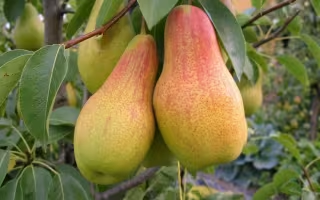
Fruits are small (average mass 58 g, maximum 75 g), relatively uniform, oval-shaped, with noticeable pear-shaped neck. Some fruits are truncated-conical, nearly cylindrical, with slight broadening at the apex, often angular and triangular at the base. Surface is relatively smooth, with numerous small, light-brown subcutaneous dots. Fruit base color is light-yellow, with weak reddish-brown covering. Pit is narrow and shallow. Pedicel is medium-thick, straight with thickening at the end. Calyx is absent. Calyx is small, open, sepals are narrow and sparse.
Flesh is yellowish, granular, juicy, slightly sour-sweet, pleasant, with distinct southern pear aroma. Towards the end of storage, flesh becomes sweet and melting. Sensory evaluation 3.7 points. Fruits contain 15.0% dry matter, 8.8% total sugars, 1.2% titratable acids, 0.8% tannins, 0.6% pectin substances, 9.2 mg/100g ascorbic acid, 201 mg/100g vitamin P.
Fruits ripen at the end of September, become suitable for consumption in late Oktyabrskaya, and can be stored until the end of December (in cold storage until the end of February). Fruit attachment is good. Yield is retained on trees after monsoon rains with strong winds, and occasionally stormy winds.
Fruits are suitable for technical processing into compote, jam, and pickling.
The variety enters fruiting at 4 years, commercial yield starts at 6 years after grafting. Yield is moderate but annual. At age 11 on the Khabarovsk State Variety Trial, it yielded 72 centners/ha. On the Nakhimovskiy Variety Trial in Primorsky Krai — 133 centners/ha, without periodicity. In collective and private gardens in Primorsky and southern districts of Khabarovsk Krai, yields at 20–25 years reach 120 kg per tree and more.
The variety is resistant to scab and other diseases.
Advantages of the variety: relatively large fruits for local varieties, good taste, suitable for late autumn and early winter consumption, good fruit attachment, resistance to scab.
Disadvantages of the variety: limited winter hardiness when grown on flat or island garden plots.
Crop & resistance
Crop
Disease resistance
Specifications
| Type of Sort | |
|---|---|
| Catalog | Catalog → Pear |
Not yet комментариев. Be the first!
Alternatives
Pear saplings · similar varieties


See also
Often considered together with this variety



Recently viewed
Products you’ve viewed on this site
Reviews · 0