



SKU #3674
·
1 468 views
Yakovlev's Favorite
Pear
User rating
0 votes0% positive reviews
No ratings yet — be the first.
Type of Sort
Autumn variety of pear
Store offers · 4 from 4 stores
Prices are updated on loadLoading offers…
Available at: 1sad · AgronomVIP · Florium · Sadovnik-sam · Сади Сад
Aggregator catalog: prices are collected automatically from store websites, normalized by AI and converted at the current exchange rate. Before ordering, confirm the price and availability on the store's website. This block is not indexed by search engines — the data is loaded after the page opens.
About product
An autumn variety was obtained at the All-Russian Research Institute of Fruit Growing and Plant Breeding named after I.V. Michurin by P.N. Yakovlev from crossing the Michurinsk variety Daughter Blanckovaya with the Belgian variety Bergamot Esperen. It is widespread in industrial and amateur gardens. It has been zoned in the Central, Central Black Earth and Middle Volga regions, but has lost its s…
Type of Sort
Autumn variety of pear
Description
An autumn variety was obtained at the All-Russian Research Institute of Fruit Growing and Plant Breeding named after I.V. Michurin by P.N. Yakovlev from crossing the Michurinsk variety Daughter Blanckovaya with the Belgian variety Bergamot Esperen. It is widespread in industrial and amateur gardens. It has been zoned in the Central, Central Black Earth and Middle Volga regions, but has lost its significance due to the appearance of new varieties.
The tree is vigorous, fast-growing, with a broadly pyramidal crown, medium leafiness, branches depart at an angle close to straight. The bark on the trunk and skeletal branches is gray, smooth. The predominant type of fruit formations are ringlets, spears.
Shoots are average in thickness, slightly kneeled, slightly curved, dark brown, with many small lenticels in the form of dots. Leaves are medium-sized, elongated oval, dark green, depart at an acute angle. The plate is bent, significantly folded, the tip is moderately pointed, twisted to one side, the base is wedge-shaped, the edge is serrated, the petiole is average. Stipules are narrow, lanceolate. Buds are of medium size, brown, sharp, pressed against each other.
Flowers are white, in an inflorescence of 7-10, saucer-shaped, slightly double, petals are white, entire, weakly closed, stigmas above the stamens. A relatively late flowering is characteristic.
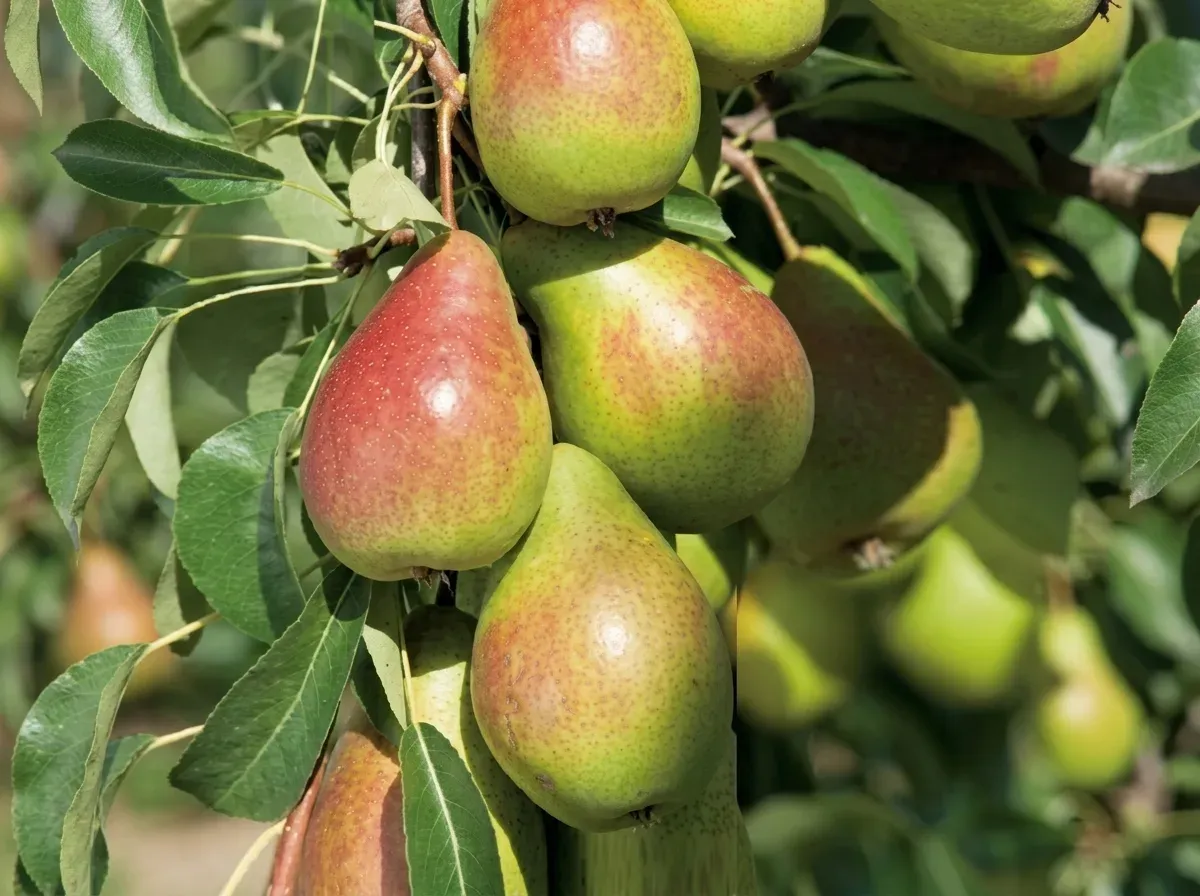
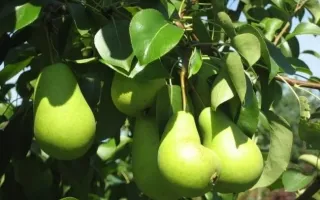
Fruits are medium-sized, medium uniform, pear-shaped, smooth. The skin is medium, dull, dense. Color at removable maturity: main greenish-yellow, covering in the form of a slight sunburn over part of the fruit. At consumer ripeness: main golden yellow, covering with a weak sunburn, many subcutaneous dots. Pedicel long, slightly curved, with an overhang at the base. Funnel is small, not wide, non-rusty, large. Calyx is deep, quite wide, with noticeable ribs. Heart is small, bulbous, seminal chambers are closed, small. Subcupular tube is long, widely conical.
The pulp is creamy, medium density, juicy, with a specific quince aroma, without astringency, with granulations, stone cells are large. Taste sweetish.
Fruits contain sugars — 8.2%, ascorbic acid — 8.4 mg/100g, P-active substances — 32.8 mg/100g, titratable acidity — 0.10%.
Removable ripeness occurs in the first half of September, consumption period until November.
Fruits are used universally.
Self-fertility is not high. The best pollinator is Duchess Summer.
Trees begin to bear fruit 5-6 years after planting in the garden, yield increases rapidly and by year 7 reaches 20 kg from a tree, during full fruiting — up to 200 c/ha or more. It differs in high winter hardiness, in epiphytotic years it is affected by scab.
Merits of the variety: high winter hardiness, yield.
Drawbacks of the variety: large trees, coarse pulp, presence of stone cells in fruits.
Several new pear varieties have been created with the participation of Yakovlev's Favorite, including the already zoned Lel variety (Vinnaya Ch Jakowlews-Lieblingssorte) by the NII Fruit Growing of Siberia named after M.A. Lisavenko.
Video · 5 videos
Suggest a video →Crop & resistance
Crop
Specifications
| Type of Sort | |
|---|---|
| Catalog | Catalog → Pear |
Not yet комментариев. Be the first!
Alternatives
Pear saplings · similar varieties




See also
Often considered together with this variety




Recently viewed
Products you’ve viewed on this site
Reviews · 0