


SKU #3710
·
584 views
Pass-Crassan
Pear
User rating
3 votes100% positive reviews
No ratings yet — be the first.
Type of Sort
Winter variety of pear
Prices in stores
from0.05 €per seedling
pack from 0.91 € per 20 pcs
3 offers from 3 stores
Store offers · 3 from 3 stores
Prices are updated on loadLoading offers…
Available at: Agro-market · Kupa · Приватний плодорозсадник Таміла · Сонцесад · Велесів сад
Aggregator catalog: prices are collected automatically from store websites, normalized by AI and converted at the current exchange rate. Before ordering, confirm the price and availability on the store's website. This block is not indexed by search engines — the data is loaded after the page opens.
About product

Winter variety. Developed in Rouan (France) by A. T. Bouabunel in 1845, and released in 1857. Approved for the North Caucasus region, widely grown in Ukraine, Georgia, North Ossetia, Armenia, Azerbaijan, Kazakhstan.
Tree is weak- or medium-growing with a dense pyramidal crown. It develops strongly in early years, then growth slows down. Main branches branch off the trunk at a sharp angle. Ba…
Type of Sort
Winter variety of pear
Description
Winter variety. Developed in Rouan (France) by A. T. Bouabunel in 1845, and released in 1857. Approved for the North Caucasus region, widely grown in Ukraine, Georgia, North Ossetia, Armenia, Azerbaijan, Kazakhstan.
Tree is weak- or medium-growing with a dense pyramidal crown. It develops strongly in early years, then growth slows down. Main branches branch off the trunk at a sharp angle. Bark on the trunk and main branches is dark gray.
Tree is suitable for cultivation with round or flat crown. Fruit-bearing type is mixed, fruiting on multi-year fruiting spurs and three-year-old shoots.
Fruits set singly or in clusters, remain firmly attached to the tree.
Shoots are short, thick, green or yellowish-green, sometimes with a brown tint. Buds are medium-sized, pointed, slightly raised. Leaves are fairly large, green, matte, elongated-oval with gradual transition to the petiole and pointed tip; leaf blade is entire near the petiole, slightly serrated in the upper part. Leaf margins are slightly wavy and slightly raised. Petiole is small.
Flowering is late.
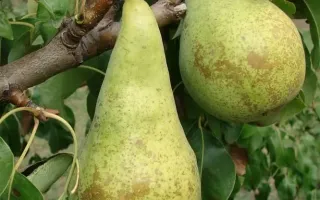
Fruits range from above average (180 g) to large size, bergamot-shaped or round with large gray dots and rusty spots. Skin is thin, dense, slightly rough, orange-yellow, golden on sunny side. Peduncle is medium length and thickness, slightly curved, straight. Deep, well-defined calyx with rounded edges and rust-colored. Basin is shallow, broad, wrinkled. Calyx is half-closed. Seed cavity is small, elongated-oval, located centrally in the fruit. Seed chambers are small, half-open. Seeds are mature.
Flesh is creamy, fragrant, very juicy, sweet, melting, with pleasant acidity, good taste. However, in dry, hot summers without irrigation, fruits exhibit a high proportion of bitterness and acidity, negatively affecting taste quality; in cool summers, flesh may not fully ripen. Under Kuban conditions, fruits contain 13.2% dry matter, 7.9% sugars, 0.5% titratable acids, 8.8 mg/100g ascorbic acid, and 76.0 mg/100g raw mass of P-active substances.
Harvesting ripeness occurs in October; consumer ripeness in January, and with artificial cooling, fruits can be stored until February. They should be harvested later, which ensures better and longer storage without shriveling. Prematurely harvested fruits develop wrinkles and reduced taste quality. Transportability is good.
Fruits are primarily used fresh, but suitable for technical processing as well.
On pear rootstocks, trees begin fruiting at 6-7 years. Fruit yield is moderate (10-15 kg/tree). For normal growth and fruiting on quince, intermediate grafting is required.
This variety performs best under intensive cultivation; fruits reach normal size and quality only on fertile soils and with adequate irrigation of fruiting trees.
Winter hardiness is low; flower buds suffer frost damage in harsh winters. Drought-tolerant. Moderately resistant to scab.
Advantages of the variety: small tree size, large dessert-flavored fruits, long storage life, and resistance to scab.
Disadvantages of the variety: high requirement for growing conditions, low winter hardiness, low yield.
Late-ripening fruit donor. In hybrid offspring with Pass-Crassan, up to 45% late-ripening forms are produced, many of which are high-yielding.
Video · 9 videos
Suggest a video →Crop & resistance
Crop
Disease resistance
Specifications
| Type of Sort | |
|---|---|
| Catalog | Catalog → Pear |
Not yet комментариев. Be the first!
Alternatives
Pear saplings · similar varieties




See also
Often considered together with this variety



Recently viewed
Products you’ve viewed on this site
Reviews · 0