


SKU #3611
·
784 views
Valesa (Daughter of Excellent)
Pear
User rating
2 votes100% positive reviews
No ratings yet — be the first.
Type of Sort
Autumn variety of pear
Store offers · 1 from 1 stores
Prices are updated on loadLoading offers…
Available at: Королевский сад · Saduua
Aggregator catalog: prices are collected automatically from store websites, normalized by AI and converted at the current exchange rate. Before ordering, confirm the price and availability on the store's website. This block is not indexed by search engines — the data is loaded after the page opens.
About product

Autumn variety selected by VSTISP, obtained by crossing Venus with Forest Beauty. Breeders: Yu. A. Petrov and N. V. Efimova. Popular in suburban gardens of Moscow and neighboring regions. Included in the State Register (regionally approved) in 2001. Tree in young age has a spreading, then broad-pyramidal, medium-dense crown, formed by curved branches with fairly large, evenly spaced rings, on…
Type of Sort
Autumn variety of pear
Description
Autumn variety selected by VSTISP, obtained by crossing Venus with Forest Beauty. Breeders: Yu. A. Petrov and N. V. Efimova. Popular in suburban gardens of Moscow and neighboring regions. Included in the State Register (regionally approved) in 2001.
Tree in young age has a spreading, then broad-pyramidal, medium-dense crown, formed by curved branches with fairly large, evenly spaced rings, on which fruiting is mainly concentrated.
Shoots are medium-sized, thick, brownish-brown. Leaves are medium-sized, smooth with wavy finely serrated edges. Petioles are long, thin, with lanceolate stipules.
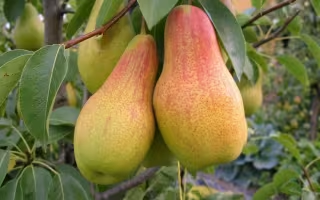
Fruits are medium to above medium size, broad pear-shaped, symmetrical, without ribs. Surface is smooth. Main color is greenish-yellow, with a light orange blush as a covering. Peduncle is medium thickness, long, slightly curved. Receptacle is medium, closed over a short nectary tube, with medium-sized receptacular lobes. Seed chambers are closed, with medium-sized dark brown seeds. Axial cavity is narrow, does not connect with the nectary tube.
Flesh is cream-colored, medium density, semi-oily, tender, juicy, slightly acidic-sweet, with excellent flavor.
Ripening is autumnal. Fruit ripens simultaneously, but harvesting is better done in two stages, starting with the largest fruits.
Fruits are good for fresh consumption and can be stored in a refrigerator until mid-November.
Fruit production begins on the 5th-7th year (from the year of growth in the nursery). Yields are abundant and regular. Winter hardiness of trees is high, at the level of older medium-Russian varieties. The variety is resistant to fungal diseases.
Advantages of the variety: high ecological stability, high regular yields, high commercial and consumer qualities of fruits.
Disadvantage of the variety: under heavy yields, fruits may become smaller.
The variety is valuable for commercial and suburban orchards, as well as for breeding.
Crop & resistance
Crop
Specifications
| Type of Sort | |
|---|---|
| Catalog | Catalog → Pear |
Not yet комментариев. Be the first!
Alternatives
Pear saplings · similar varieties




See also
Often considered together with this variety




Recently viewed
Products you’ve viewed on this site
Reviews · 0