


SKU #3594
·
1 126 views
Moscow Bergamot
Pear
User rating
0 votes0% positive reviews
No ratings yet — be the first.
Type of Sort
Autumn variety of pear
Store offers · 2 from 2 stores
Prices are updated on loadLoading offers…
Available at: AgronomVIP · Agromir
Aggregator catalog: prices are collected automatically from store websites, normalized by AI and converted at the current exchange rate. Before ordering, confirm the price and availability on the store's website. This block is not indexed by search engines — the data is loaded after the page opens.
About product

Autumn variety from the Moscow Agricultural Academy named after K. A. Timiryazev. Exact genetic origin is not established. It is likely a third-generation seedling from repeated crossings between Ussuri pear and Western European varieties. Breeders: S. T. Chizhov, S. P. Potapov, N. V. Agafonov, A. V. Isachkin, A. G. Matushkin, V. I. Susov, I. I. Khanzian. Transferred to the State Variety Testing…
Type of Sort
Autumn variety of pear
Description
Autumn variety from the Moscow Agricultural Academy named after K. A. Timiryazev. Exact genetic origin is not established. It is likely a third-generation seedling from repeated crossings between Ussuri pear and Western European varieties. Breeders: S. T. Chizhov, S. P. Potapov, N. V. Agafonov, A. V. Isachkin, A. G. Matushkin, V. I. Susov, I. I. Khanzian. Transferred to the State Variety Testing Institute (GSI) in 1997. Recommended for cultivation in the Central region.
Medium-stature tree, oval-shaped crown, medium density, compact. High bud break and shoot formation capability. Fruit set is concentrated, primarily on old and young spurs.
Shoots are brownish-light-brown, buds are tightly pressed; internodes are shortened. Petioles are medium in number, large, elongated. Leaves are medium-sized, oblong-oval in shape, leaf margin is finely toothed. Petiole is short, above average thickness or thick. Stipules are above average length.
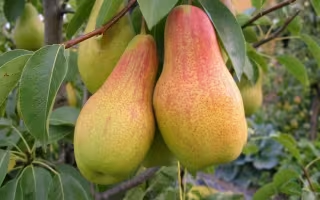
Fruits are above average size (mass 151 g), bergamot-shaped, slightly ribbed. Skin is medium thickness. Main color of ripe fruits is light yellow-green, no covering color or slight brownish-red blush. Subcutaneous dots are large, medium number. Fruit stem is very short or short, thick. Calyx tube is narrow, small. Receptacle is narrow, small, sometimes ribbed. Calyx is half-open.
Flesh is medium density, juicy, sweet-sour, good flavor. Fruit attractiveness is rated 4.1 points, taste quality 3.9 points. Chemical composition: 13.5% dry matter, 8.1% total sugars, 0.84% total acids.
Harvest maturity occurs in the first decade of September, when the green main color of fruits lightens. Consumption period lasts until the third decade of September; fruits store up to 1.5–2 months in refrigeration.
Grafted plants begin fruiting on the 4th–5th year. Average yield in the fruit experimental orchard of TSXA is 19 kg/tree, productivity 4.12 kg/m² crown projection.
Highly winter-hardy, after severe winter of 1986/87, minor damage was noted. Highly resistant to scab and brown spot, resistant to fruit rot.
Advantages of the variety: high winter hardiness, prolonged flowering period, compact crown, good productivity, high resistance to scab, large fruit size.
Disadvantages of the variety: relatively short consumption period; in dry years accumulates excessive bitterness and acidity in fruits, reducing average taste rating.
Video · 3 videos
Suggest a video →Crop & resistance
Crop
Disease resistance
Specifications
| Type of Sort | |
|---|---|
| Catalog | Catalog → Pear |
Not yet комментариев. Be the first!
Alternatives
Pear saplings · similar varieties




See also
Often considered together with this variety



Recently viewed
Products you’ve viewed on this site
Reviews · 0