


SKU #3752
·
439 views
Pear Thin-branching
Pear
Prices in stores
from0.33 €per seedling
pack from 16.6 € per 50 pcs
14 offers from 3 stores
Type of Variety
Summer variety of pear
Your mark
1 vote
100% positive ratings
Store offers · 14 from 3 stores
14 offers in 3 stores — from 0.33 € per seedling.
Available at: budzona-net-ua · Панські Сади · volyntools-com-ua
Prices are collected automatically from store websites and converted at the current exchange rate. Check the price and availability on the store website before ordering.
Description
An old medium Russian variety of folk selection, summer ripening. Known since the 18th century. It was regionally approved in the Northwest, Central, Volga-Vyatka, Middle and Lower Volga regions. Mainly distributed in the northern part of the middle belt of Russia up to St. Petersburg, Yaroslavl, Kostroma.
Trees are strong-growing, large, with pyramidal or broad-pyramidal crowns.
Shoots are light-brown with a yellowish tint. Buds are numerous, light-colored, large, elongated, convex. Fruit set on ring-like structures. Leaves are medium-sized, dark green. Leaf blade is completely smooth, without wavy edges, nearly flat or slightly curved along the central vein. Leaf tip is short-pointed. Petiole is long, thin, pinkish.
Number of flowers per inflorescence ranges from 4 to 6. Buds are white. Flower corolla is saucer-shaped, without double-petaled form. Flower size is medium. Petal margins are entire. Petals are not fused. Stigmas are at the same level as stamens. Stigmas are free.
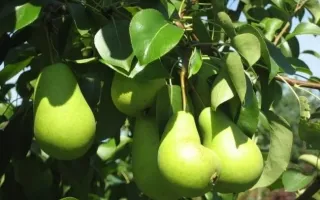
Fruits are medium to slightly smaller than average, with a regular pear shape, yellow-green or light-yellow, sometimes with a slight blush on the sun-exposed side. Pedicel is very long, thick, curved like an arch. Calyx is absent. Receptacle is closed, sometimes open. Receptacle is very small. Seed cavity is elongated and small. Seeds are elongated, brown.
Flesh is creamy, coarse, slightly dry, sour-sweet, slightly bitter, of average quality. Becomes mealy upon overripening.
Trees begin fruiting at the age of 8–10 years. Yield is high and annual, up to 250 kg per tree. Cold resistance is high. Trees withstand the lowest extreme temperatures, surpassing almost all pear varieties in the middle zone of Russia in frost tolerance.
Advantages of the variety: high cold resistance and high yield.
Disadvantages of the variety: late fruiting onset, small fruit size, low taste quality of fruits, high growth habit.
Crop & resistance
Crop
Specifications
| Type of Variety | |
|---|---|
| Catalog | Catalog → Pear |
No reviews yet. Be the first to share your experience.
Alternatives
Pear saplings · similar varieties




See also
Often considered together with this variety



Recently viewed
Products you’ve viewed on this site
Reviews