


SKU #3757
·
426 views
Morning Freshness
Pear
User rating
0 votes0% positive reviews
No ratings yet — be the first.
Type of Sort
Summer variety of pear
About product

Summer variety. Selected from seedlings of freely pollinated Korean varieties. Breeders: E. N. Sedov (All-Russian Research Institute of Fruit Crop Breeding), G. V. Yeremin (Crimean Experimental Selection Station of VIR). Under state testing since 1994. Recommended for cultivation in the North Caucasus region.
Tree is weak-growing (3.5–4.0 m at 10 years old). Crown is round, medium density. Bar…
Type of Sort
Summer variety of pear
Description
Summer variety. Selected from seedlings of freely pollinated Korean varieties. Breeders: E. N. Sedov (All-Russian Research Institute of Fruit Crop Breeding), G. V. Yeremin (Crimean Experimental Selection Station of VIR). Under state testing since 1994. Recommended for cultivation in the North Caucasus region.
Tree is weak-growing (3.5–4.0 m at 10 years old). Crown is round, medium density. Bark on trunk and main branches is smooth, gray-brown. Branching is basal-tonic, fruiting is concentrated on whorls and shoots.
Shoots of medium thickness, straight, brown. Buds are sparse, large, white. Leaves are large, oval, dark green. Leaf blade slightly concave, smooth, leaf margin serrated. Pubescence absent in mature leaves, present along midrib on upper and lower sides of young leaves. Petiole short, weakly pubescent, light green. Stipules large, awl-shaped.
Flowers are large, saucer-shaped, white. Stigmas 10–12 mm, pubescent at base. Stigma styles are at the same level as stamens. Inflorescence contains 7–10 flowers. Flowering in Krasnodar Krai occurs in the second half of April to early May.
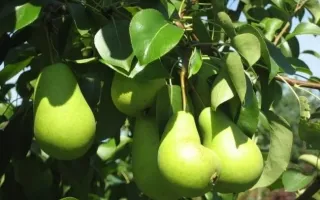
Fruits are single, weighing 115 g (maximum up to 180 g), reverse-egg-shaped. Skin is shiny, bright green, without covering color, with small creamy subcutaneous spots. Peduncle is medium length and thickness. Nectary absent. Receptacle is medium, calyx is open. Heart and seed chambers are medium size, seeds are egg-shaped, medium. Axial cavity absent, subcalyx tube weakly visible, narrow.
Flesh is light-cream, crisp, very juicy, aromatic, pleasant taste. Sensory evaluation: fresh fruit taste 4.6 points, appearance 4.5 points, compotes 4.2 points. Fruits contain 14% dry matter, 8.3% sugars, 0.2% titratable acids, 5 mg/100g ascorbic acid, 1.5% pectic substances.
Harvest maturity occurs in early August. Fruit attachment is strong. Consumer period is 2–3 weeks.
Partially self-fertile (up to 30% fruit set under artificial self-pollination). Best pollinators are Bronze, Kieffer, Eastern Golden, and other East Asian varieties.
Very early fruiting variety. Begins fruiting in 3–4 years. Yield increases gradually, reaching 70–100 kg per tree at age 12. Fruit production is regular.
Exhibits sufficient winter hardiness in southern fruit-growing zones. Drought resistance is moderate, responds well to irrigation. Shows comprehensive resistance to fungal and bacterial diseases.
Advantages of the variety: weak growth, early fruiting, comprehensive disease resistance, suitability for intensive and super-intensive cultivation systems.
Disadvantages of the variety: weak winter hardiness in central fruit-growing zones.
Crop & resistance
Crop
Disease resistance
Specifications
| Type of Sort | |
|---|---|
| Catalog | Catalog → Pear |
Store offers
Prices are updated on loadLoading offers…
Aggregator catalog: prices are collected automatically from store websites, normalized by AI and converted at the current exchange rate. Before ordering, confirm the price and availability on the store's website. This block is not indexed by search engines — the data is loaded after the page opens.
Not yet комментариев. Be the first!
Alternatives
Pear saplings · similar varieties






See also
Often considered together with this variety


Recently viewed
Products you’ve viewed on this site
Reviews · 0