


SKU #3758
·
407 views
Pear Faber (Madame Faber)
Pear
Type of Variety
Autumn variety of pear
Your mark
0 votes
0% positive ratings
Store offers · 2 from 2 stores
2 offers in 2 stores — from 6.15 € per seedling.
Available at: mascus-fi · Садовая Деревня
Prices are collected automatically from store websites and converted at the current exchange rate. Check the price and availability on the store website before ordering.
Description
An autumn variety, bred in 1863 by the fruit grower M. Faure (France). A seedling from an open-pollination of the Bere Ardanpon variety. It was zoned in Krasnodar Territory and Kabardino-Balkaria. Recently, its prevalence has been decreasing.
The tree is medium-growing with a rather dense, wide pyramidal crown.
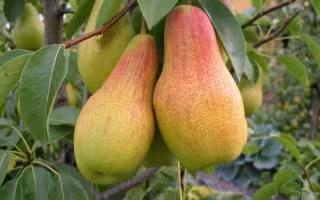
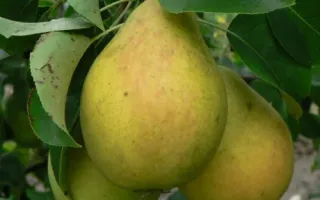
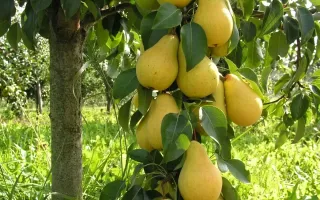
Fruits are above average in size, weighing 150-180 g, of an original round or widely pear-shaped shape with a bumpy surface and a fleshy growth near the stem. The skin is initially light green, turns straw yellow upon ripening, often with weak blush on the sunny side, dotted with numerous small gray dots, fragrant, slightly stiff to the touch, dense, sometimes has slight russeting at the base of the stem. Greenish stripes run from the stem. In storage, the skin is dry and somewhat rough. The stem is quite long, straight or arcuately curved, thick, knobby, with a large fleshy funnel at the lower end; it is more or less obliquely inserted and surrounded by convex folds at its base. Funneling is absent or poorly expressed. The calyx cavity is large, deep, and ribbed. The calyx itself is small, closed, or almost closed.
The flesh is yellowish-white, oily, juicy, sweet, fragrant, usually of very good taste; however, sometimes a slight astringency may be noticeable. Under the conditions of the Kuban region, the fruits contain sugars — 10.2%, titratable acids — 0.4%, dry matter — 16.9%, ascorbic acid — 5.3 mg/100g, P-active catechins — 36.8 mg/100g of raw mass.
Harvest maturity occurs on September 1-5. They can be stored for about a month in storage; sometimes, overripening, they "swell". The fruits do not hold firmly on the tree.
Good pollinators for this variety are Williams, Favorite Klapp's, Forest Beauty, Lucius, Bere Zhiffar.
It grows well both on pear and quince rootstocks. Trees grafted onto pear begin to bear fruit in 6-7 years; those grafted onto quince — in the 4th year. The yield is abundant but uneven from year to year. Average yield in the central part of Kuban at the age of 15-18 years — 160-180 c/ha (centners per hectare).
The tree is not sufficiently drought resistant; its frost hardiness is medium. The variety is relatively resistant to scab but susceptible to white spot disease.
Merits of the variety: high fruit quality, resistance to scab.
Demerits of the variety: low drought resistance.
Crop & resistance
Crop
Disease resistance
Specifications
| Type of Variety | |
|---|---|
| Catalog | Catalog → Pear |
No reviews yet. Be the first to share your experience.
Alternatives
Pear saplings · similar varieties






See also
Often considered together with this variety




Recently viewed
Products you’ve viewed on this site
Reviews