


SKU #3759
·
749 views
Fevralskaya (Imunnaya)
Pear
User rating
0 votes0% positive reviews
No ratings yet — be the first.
Type of Sort
Winter variety of pear
Prices in stores
from0.14 €per seedling
pack from 13.95 € per 100 pcs
1 offer from 1 store
Store offers · 1 from 1 stores
Prices are updated on loadLoading offers…
Available at: Vegan-Tehnika
Aggregator catalog: prices are collected automatically from store websites, normalized by AI and converted at the current exchange rate. Before ordering, confirm the price and availability on the store's website. This block is not indexed by search engines — the data is loaded after the page opens.
About product

Winter variety selected by SKNIIHGIP, obtained by pollinating Decanka winter with a pollen mixture (Josefina Mechelska + Bere Ardanpon). Breeders: P. P. Kostyk, A. I. Tereshchenkova, L. V. Khachetlova. The variety is grown in Kabardino-Balkaria, Adygea, and Stavropol Krai.
The tree has a narrowly pyramidal crown in its youth, and with age, an inverted pyramidal crown with densely spaced skel…
Type of Sort
Winter variety of pear
Description
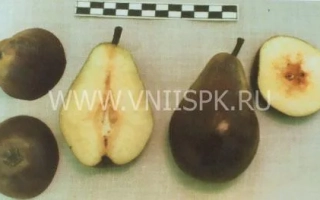
Winter variety selected by SKNIIHGIP, obtained by pollinating Decanka winter with a pollen mixture (Josefina Mechelska + Bere Ardanpon). Breeders: P. P. Kostyk, A. I. Tereshchenkova, L. V. Khachetlova. The variety is grown in Kabardino-Balkaria, Adygea, and Stavropol Krai.
The tree has a narrowly pyramidal crown in its youth, and with age, an inverted pyramidal crown with densely spaced skeletal branches. Fruit-bearing type is mixed.
Shoots are straight, round, olive-yellow. Leaves are elongated, light green, smooth, matte, with finely serrated edges. Petioles are bare, with large, lanceolate stipules.
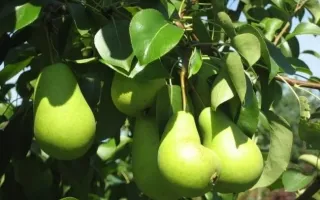
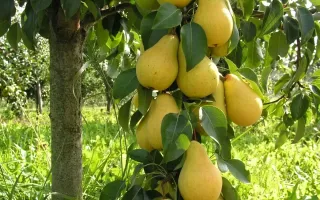
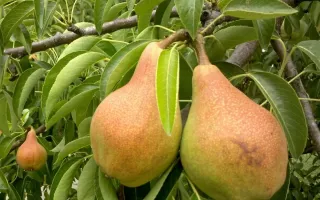
Fruits are above-average size, broad-pear-shaped, symmetrical, slightly ribbed. Skin is smooth, dry, shiny when stored. Fruit color is light yellow. Peduncle is straight. No calyx. Calyx is closed, plate is small and ridged. Seed chambers are semi-open, with a small amount of dark brown, fully formed seeds, the rest are rudimentary.
Flesh is white with yellowish hue, oily, slightly acidic-sweet dessert flavor. Chemical composition of fruits: dry matter — 17.0%, sugars — 11.6%, titratable acids — 0.18%, ascorbic acid — 4.1 mg/100g.
Harvest ripeness occurs at the end of September. Only during storage, at 0+2°C, fruits ripen further and acquire their characteristic excellent flavor. Consumption period — December to March.
Fruits are good for fresh consumption during winter.
Fruit-bearing begins at 6-7 years. Yield is good, 290 centners per hectare, compared to the control variety Kure 210 centners per hectare. High winter hardiness. The variety is not affected by fungal diseases.
Advantages of the variety: winter ripening period, high fruit quality, resistance to fungal diseases.
Disadvantages of the variety: fruit size reduction under heavy fruit load.
Crop & resistance
Crop
Disease resistance
Specifications
| Type of Sort | |
|---|---|
| Catalog | Catalog → Pear |
Not yet комментариев. Be the first!
Alternatives
Pear saplings · similar varieties




See also
Often considered together with this variety





Recently viewed
Products you’ve viewed on this site
Reviews · 0