


SKU #3772
·
791 views
Yanvarskaya
Pear
User rating
2 votes100% positive reviews
No ratings yet — be the first.
Type of Sort
Winter variety of pear
Store offers · 1 from 1 stores
Prices are updated on loadLoading offers…
Available at: Растения 24 · Agromir
Aggregator catalog: prices are collected automatically from store websites, normalized by AI and converted at the current exchange rate. Before ordering, confirm the price and availability on the store's website. This block is not indexed by search engines — the data is loaded after the page opens.
About product

Winter variety developed by VNIISPК in 1955 through hybridization of Bere Tolstobezhka (Ussuriian Pear Ch Bere Dilly) with Lesnaya Krasavitsa. Breeders: E. N. Sedov, A. V. Parshin, N. G. Krasova, M. V. Mikhеeva. Passed State Testing in the middle zone of fruit growing, mainly grown in home gardens by amateur gardeners. Of interest for public and farmer orchards. Trees are not very large, with a…
Type of Sort
Winter variety of pear
Description
Winter variety developed by VNIISPК in 1955 through hybridization of Bere Tolstobezhka (Ussuriian Pear Ch Bere Dilly) with Lesnaya Krasavitsa. Breeders: E. N. Sedov, A. V. Parshin, N. G. Krasova, M. V. Mikhеeva.
Passed State Testing in the middle zone of fruit growing, mainly grown in home gardens by amateur gardeners. Of interest for public and farmer orchards.
Trees are not very large, with a wide-pyramidal compact crown. Main branches branch off at nearly right angles, with tips pointing upwards. Bark on trunk and main branches is peeling.
Shoots are curved, round in cross-section, brown, without hairs. Leaves are medium-sized, broad, rounded, slightly pointed, dark green, smooth, glossy, with delicate venation, rarely arranged on shoots. Leaf blade is curved downward. Leaf margin is finely toothed, smooth. Petiole is long, thin.
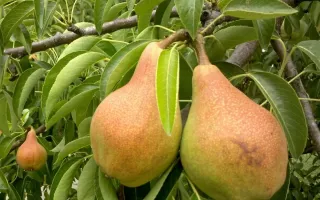
Fruits are medium-sized, broad pear-shaped, one-sided, broadly ribbed, slightly skewed. Skin is smooth, rough, dry, dull. Main color at harvest time is greenish, consumer color is greenish-yellow. Cover color appears as a light brownish-red blush on the sun-exposed side, developing into a red blush at consumer maturity. Subcutaneous dots are numerous, green, clearly visible. Pedicel is curved, upright, with no depression. Receptacle is open, with a small, ridged plate. Seed cavity is medium, bulbous, seed chambers closed and small. Sub-receptacle tube is short, wide, dish-shaped.
Fruit flesh is white with a greenish tint, dense, juicy, finely textured, sweet. Chemical composition: total sugar content — 8.2%, titratable acids — 0.11%, ascorbic acid — 6.0 mg/100g, P-active substances — 87 mg/100g, pectin substances — 3.1%.
Harvesting maturity in the Oryol region occurs in mid-September. Fruits stored in a refrigerator (+2°C) remain fresh for 3 months, at -1°C for 4 months, in polyethylene bags (+2°C) for about 5 months with low waste (5%). After storage, fruits require ripening at 18-20°C. The longer the storage period, the longer (up to 20-25 days) the ripening period should be. Harvesting underripe fruits of this variety and storing them at low temperatures causes flesh hardening and toughening, which does not occur when stored at +2°C and above. However, this shortens storage life.
Yield is good, averaging 100-130 centners per hectare annually. The variety is characterized by moderate winter hardiness; in severe winters, bark, wood, and fruit buds freeze to 3.0 points in mid-winter. Resistance to scab is moderate.
Advantages of the variety: long storage and consumption period for fruits.
Disadvantages of the variety: insufficient resistance to low critical winter temperatures.
Video · 1 video
Suggest a video →Crop & resistance
Crop
Specifications
| Type of Sort | |
|---|---|
| Catalog | Catalog → Pear |
Not yet комментариев. Be the first!
Alternatives
Pear saplings · similar varieties







See also
Often considered together with this variety





Recently viewed
Products you’ve viewed on this site
Reviews · 0