



SKU #3749
·
302 views
Pear Tema
Pear
User rating
0 votes0% positive reviews
No ratings yet — be the first.
Type of Sort
Autumn variety of pear
About product
An early-autumn variety developed by A.M. Lukashov in Khabarovsk in 1909 from pollination of the Baltic variety 'Finnish Yellow' with Ussuri pear pollen. In 1917, the hybrids entered fruiting stage; from this family of hybrid seedlings, four varieties — Tema, Polya, Olga, and Lida — were selected. Under the collective name 'Lukashovki', these varieties formed the basis of cultivated pears on the…
Type of Sort
Autumn variety of pear
Description
An early-autumn variety developed by A.M. Lukashov in Khabarovsk in 1909 from pollination of the Baltic variety 'Finnish Yellow' with Ussuri pear pollen. In 1917, the hybrids entered fruiting stage; from this family of hybrid seedlings, four varieties — Tema, Polya, Olga, and Lida — were selected. Under the collective name 'Lukashovki', these varieties formed the basis of cultivated pears on the Far East. Approved for cultivation in the West Siberian and Far Eastern regions.
Tema — the largest-fruited among them — holds a leading position and is currently cultivated in Primorsky and Khabarovsk regions, Jewish Autonomous Region, southern areas of Amur and Sakhalin Oblasts. It is also grown in northern areas of Amur Oblast and Khabarovsk Krai, along the Baikal-Amur Mainline up to Komsomolsk-on-Amur, and also appears in collective gardens along the lower reaches of the Amur and the Sea of Okhotsk coast. Beyond the Far East, it grows in Zabaykalsky, Eastern and Western Siberia, Altai Krai up to Zaural’ye.
In orchards and nurseries in Primorsky and Khabarovsk regions, 'Lukashovki', including Tema, accounted for up to 50% or more of all fruit crops. The largest plantations are concentrated in Khabarovsk and Primorsky regions. In collective gardens of urban residents and suburban gardens of rural dwellers, 'Lukashovki' also predominate.
The tree is vigorous, reaching large sizes. The crown is round-pyramidal, with skeletal branches emerging in whorls and at sharp angles from the trunk. The bark of the trunk and skeletal branches is brown and flaking.
Shoots are straight, well-developed, brownish-green. Buds are round, slightly convex, and fruit buds form on one-year growths as spear-shaped and simple ring-like structures. Leaves on one-year shoots are egg-shaped, with a rounded base, pointed apex, nearly wedge-shaped, slightly curved blade. The serration is fine-toothed. The upper surface of the leaf is dark green and glossy, the lower surface is light greenish, lightly hairy along the main vein. The petiole is long, thin, and hairy.
Flowers are medium-sized, white, single-colored, with the stigma column fused at the base and positioned below the brown anthers. Pedicels are long, medium-thick, slightly hairy.
The fruits are the largest among 'Lukashovki'. On young trees, average fruit weight is 150–200 g, in mature fruiting stage 115–130 g, with maximum up to 350–400 g.
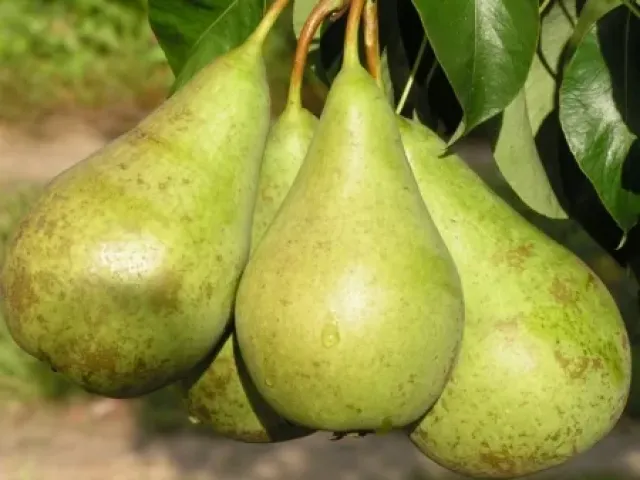
The fruits are pear-shaped, slightly asymmetrical. The main fruit color is light yellow, with a weak, diffuse blush on the sun-exposed side. The skin has numerous dark lenticels. The peduncle is long (2–4 cm), thick, slightly curved, fitting into a shallow, narrow cup formed by unequal protrusions. The receptacle is small, and the calyx is open. The ovary is upper, sharply defined. The seed chambers are closed. Seeds are light brown, egg-shaped.
The flesh is white, juicy, with a loose texture, slightly tart-sweet, slightly astringent, of acceptable flavor.
Fruits contain total sugars — 10.9%, titratable acids — 1.0%, tannins — 0.6%, pectin — 0.3%, ascorbic acid — 19.5 mg/100g.
Fruits ripen in the first decade of September. Ripe fruits drop easily, especially during monsoon rains with strong winds.
Fruits are suitable for consumption after 3–5 days of storage, can be stored up to 20 days, and up to two months in storage facilities with controlled climate. Main use — fresh consumption, as well as for making compotes, marinades, jams, mashes, fruit wine, and juice. Fruit quality is up to 90%, including first-class fruit up to 50%.
The variety is self-incompatible; best pollinators — Olga, Palmira, Polya.
Trees enter fruiting at 3–4 years after grafting, heavy fruiting from 6–8 years. Yield is annual and stable, average, in commercial orchards with large areas — 120 centners/ha, maximum — 260 centners/ha. In the Lukashov Fruit and Berry Nursery, over 32 years of record-keeping (from age 5 to 37), a total yield of 2362 kg per tree was obtained.
The variety has high winter and frost resistance in elevated locations. On low, waterless plains, trees often freeze. The variety is resistant to scab, but susceptible to codling moth and fruit borer.
Advantages of the variety: relatively high winter and frost resistance, relatively large fruits, market demand, high annual yield, relatively resistant to overwatering and soil moisture deficiency.
Disadvantages of the variety: mediocre flavor, limited shelf life for fresh consumption, weak fruit attachment during harvest.
The variety is widely used in breeding for winter hardiness, yield, and fruit size, both on the Far East and beyond, in new northern horticultural zones.
Crop & resistance
Crop
Specifications
| Type of Sort | |
|---|---|
| Catalog | Catalog → Pear |
Store offers
Prices are updated on loadLoading offers…
Aggregator catalog: prices are collected automatically from store websites, normalized by AI and converted at the current exchange rate. Before ordering, confirm the price and availability on the store's website. This block is not indexed by search engines — the data is loaded after the page opens.
Not yet комментариев. Be the first!
Alternatives
Pear saplings · similar varieties




See also
Often considered together with this variety



Recently viewed
Products you’ve viewed on this site
Reviews · 0