


SKU #3667
·
783 views
Leven
Pear
User rating
2 votes50% positive reviews
No ratings yet — be the first.
Type of Sort
Winter variety of pear
Prices in stores
from3.38 €per seedling
pack from 3.48 € per 1 pcs
6 offers from 3 stores
Store offers · 6 from 3 stores
Prices are updated on loadLoading offers…
Available at: БаТаня · DREVO · Kustik · Plodsad · Posadka · Rassadnik · Sadim · Ycadba
Aggregator catalog: prices are collected automatically from store websites, normalized by AI and converted at the current exchange rate. Before ordering, confirm the price and availability on the store's website. This block is not indexed by search engines — the data is loaded after the page opens.
About product

Winter variety, developed at the North Caucasus Regional Institute of Horticulture and Viticulture by crossing the varieties Alexander Dulyar and Bere Napoleon. Breeders: L. M. Sergeev, E. I. Kostetskaia, N. V. Mozhar. Approved for the North Caucasus region. Widely grown in private and farmer orchards. Trees have restrained growth, with a rounded, moderately dense crown. Branches emerge from the…
Type of Sort
Winter variety of pear
Description
Winter variety, developed at the North Caucasus Regional Institute of Horticulture and Viticulture by crossing the varieties Alexander Dulyar and Bere Napoleon. Breeders: L. M. Sergeev, E. I. Kostetskaia, N. V. Mozhar. Approved for the North Caucasus region. Widely grown in private and farmer orchards.
Trees have restrained growth, with a rounded, moderately dense crown. Branches emerge from the trunk at nearly straight angles. Bark on the trunk and branches is smooth.
Shoots are curved, reddish-brown, smooth, with slightly toothed leaf margins. Petioles are bare and of medium length.
Flowers are medium-sized, white, with oval petals.
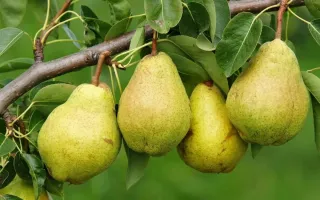
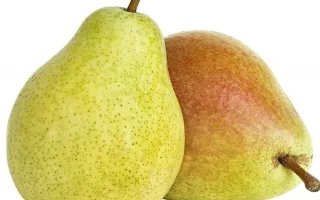
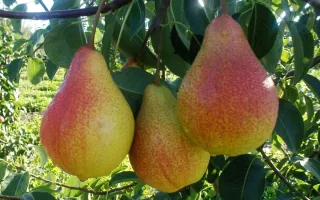
Fruits are large, average weight 220 g, very large (up to 400 g) on young trees, with a broad pear shape, broad ribbed, with slightly bumpy surface. Skin is dense, oily, shiny during harvest maturity, greenish-yellow in consumer stage, with a brownish-red covering on most of the fruit. Numerous, large, clearly visible brown lenticels are present beneath the skin. In some years, the fruit may exhibit rust on the calyx and small spots across the entire surface. The peduncle is short, medium thickness, with a flared attachment point, straight or slightly curved. The fruit's cavity is deep and slightly bumpy. The calyx is half-open, small, non-deciduous, with a wide, deep, bumpy receptacle.
Flesh is white, juicy, finely textured, with a pleasant dessert-like sweet-sour taste. Sensory evaluation: 4.4–4.6 points. In the Kuban region, fruits contain 7.8% soluble solids, 4.7% sugars, 0.6% titratable acids, 4.2 mg/100g ascorbic acid, and 68 mg/100g raw mass of P-active catechins.
Harvest maturity occurs at the end of September to beginning of October; consumer maturity in December, and fruits can be stored in refrigeration until January–February.
Despite their large size, fruits remain firmly attached to the tree. Transportability is good.
Early bearing variety; trees begin fruiting 4–5 years after planting in orchards. Annual fruiting, yield 180 centners/ha. High drought and cold resistance, disease incidence from scab is up to 1 point.
Advantages of the variety: early fruiting, restrained tree growth, late ripening, high sensory and commercial quality of fruits. Suitable for denser planting.
Disadvantages of the variety: slightly affected by scab.
Crop & resistance
Crop
Disease resistance
Specifications
| Type of Sort | |
|---|---|
| Catalog | Catalog → Pear |
Not yet комментариев. Be the first!
Alternatives
Pear saplings · similar varieties




See also
Often considered together with this variety





Recently viewed
Products you’ve viewed on this site
Reviews · 0