


SKU #3663
·
2 111 views
Cure (Williams Winter)
Pear
User rating
6 votes83% positive reviews
No ratings yet — be the first.
Type of Sort
Winter variety of pear
Prices in stores
from1.76 €per seedling
pack from 1.76 € per 1 pcs
6 offers from 6 stores
Store offers · 6 from 6 stores
Prices are updated on loadLoading offers…
Available at: Agro-market · Drevolaz · Панські Сади · Plodo Market · Posadka · sadunadaci.com.ua · Все Росте
Aggregator catalog: prices are collected automatically from store websites, normalized by AI and converted at the current exchange rate. Before ordering, confirm the price and availability on the store's website. This block is not indexed by search engines — the data is loaded after the page opens.
About product

The winter variety Cure originated as a chance seedling. It was discovered in 1760 in the Fromento forest (France) by the curé Léroux, who is credited with promoting this variety. The variety was evaluated in the North Caucasus region and is widely grown in Dagestan, Kabardino-Balkaria, Chechnya and Ingushetia, North Ossetia, Stavropol and Krasnodar regions, all zones of Ukraine, Moldova, Azerba…
Type of Sort
Winter variety of pear
Description
The winter variety Cure originated as a chance seedling. It was discovered in 1760 in the Fromento forest (France) by the curé Léroux, who is credited with promoting this variety.
The variety was evaluated in the North Caucasus region and is widely grown in Dagestan, Kabardino-Balkaria, Chechnya and Ingushetia, North Ossetia, Stavropol and Krasnodar regions, all zones of Ukraine, Moldova, Azerbaijan, Armenia, and the republics of Central Asia.
A strong-growing tree with a broad-pyramidal, dense, well-leafed crown. Main branches diverge from the trunk at an angle of 45-50°. Branch tips droop under fruit load. Trees are characterized by great longevity. Bark on the trunk and main scaffold branches is gray with cracks, on young branches it is smooth and gray. Bears fruit mainly on 3-4-year-old wood, occasionally on 2-year-old wood, and also on fruit buds.
Buds of medium length or long, curved, medium thickness, light-brown. In the upper part of one-year-old shoots, the bark is burgundy-brown with slight hairs. Buds are sparse, medium-sized, oval, light-gray. Buds are medium-sized, conical, pointed, slightly irregular, dark-brown with gray scales. Good bud-forming ability. Leaves are medium-sized, nearly round or broadly egg-shaped, with a short tip, dark green, leaf blade thick, leathery, smooth, glossy, margins slightly uplifted upwards, tip curled downward, fine serrated edges. Leaf petiole is small, thin, often burgundy-colored.
Flowering is early. Flowers are fairly large, white, with dark-pink stamens.
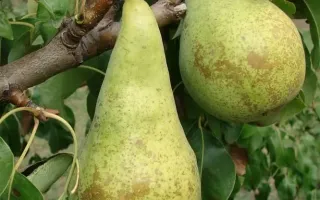
Fruits are above average size (mass 160-190 g) or large (200-250 g), elongated pear-shaped, slightly unequal-sided. The fruit tapers to a truncated cone at the calyx. Skin is smooth, dense, thick, matte, green when picked, light-yellow when ripe, sometimes with slight pinkish blush and numerous small, barely noticeable subcutaneous dots. Some fruits have a characteristic rust-brown stripe running from the calyx to the pedicel. Pedicel is long, medium thickness with thickening at the point of attachment to the branch, slightly curved, obliquely attached, firmly attached to the fruit and seemingly transitions into a fleshy bump at this point. Calyx cavity is shallow, wide, smooth, often slightly rusted. Calyx is large, open, with large elongated sepals shaped like a star. Seed cavity is small, elongated, surrounded by numerous granules. Seed chambers are egg-shaped, close, low-seeded. Seeds are yellow-brown, elongated.
Flesh is white, juicy, fine-grained, medium density, slightly tart-sweet, with slight bitterness and stone cells around the seed cavity, with mild aroma. Flavor varies from 3 to 3.5 points depending on growing conditions. Flavor is mediocre when harvested early, but improves during storage. Fruits contain 10.8% dry matter, 6.5% sugars, 0.7% titratable acids, 3.8 mg/100g ascorbic acid, 38.6 mg/100g raw material of P-active catechins.
Harvest maturity occurs in Kuban from September 25 to October 8.
Fruits usually set in clusters and hold firmly on the tree. In storage, they ripen 15-20 days after harvest, with storage duration from one to two months. Upon ripening, fruits quickly turn brown and spoil, requiring prompt sale; overripe fruits become mealy. Transportability is good.
Fruits are used for fresh consumption and processing. In conservation (composts) they yield mediocre products — 3.5 points.
Best pollinators: Williams, Klappa’s Favorite, Olivier de Serre. Cure is triploid and has sterile pollen.
Enters fruiting stage at 5-6 years, on quince at 4-5 years after planting in a garden. High productivity. Average yield in central Kuban at 17-20 years — 150-180 centners/ha, in foothill zones at 24-26 years — 200-250 centners/ha. Grows well and bears fruit on both wild pear and quince rootstocks. On quince rootstocks, trees grow well and often revert to their own roots. Sapling growth in nurseries is very vigorous. Used in nurseries as an intermediate graft for pear varieties that fail to thrive on quince. Pruning is usually limited to thinning dense branches in the crown and light pruning of continuation shoots.
The variety is relatively low-maintenance and can grow on all soils, but performs best on light, sufficiently moist soils. Shows increased heat requirement; in cool summers, fruits do not reach adequate sugar content.
Trees are moderately cold-hardy and drought-tolerant. After frost damage, trees recover quickly and continue to fruit abundantly. Moderately resistant to scab; in epidemic years, infection exceeds 2 points.
Advantages of the variety: periodic but high yield, winter hardiness of trees, low requirement for growing conditions.
Disadvantages of the variety: mediocre fruit flavor, fruit size reduction under heavy fruit load.
Video · 5 videos
Suggest a video →Crop & resistance
Crop
Disease resistance
Specifications
| Type of Sort | |
|---|---|
| Catalog | Catalog → Pear |
Not yet комментариев. Be the first!
Alternatives
Pear saplings · similar varieties




See also
Often considered together with this variety





Recently viewed
Products you’ve viewed on this site
Reviews · 0