


SKU #3684
·
1 214 views
Nart
Pear
User rating
3 votes67% positive reviews
No ratings yet — be the first.
Type of Sort
Winter variety of pear
Store offers · 8 from 7 stores
Prices are updated on loadLoading offers…
Available at: ВіоСад · Biosad · Чудеса Саду · Квіти Буковини · Райська Долина · Сади Буковини · Семена Буковины · Yaskrava Klumba
Aggregator catalog: prices are collected automatically from store websites, normalized by AI and converted at the current exchange rate. Before ordering, confirm the price and availability on the store's website. This block is not indexed by search engines — the data is loaded after the page opens.
About product

Early winter variety selected by SKNIIGiPS, obtained by pollinating a Kiffner seedling with a pollen mixture (Forest Beauty + Bere Ardanpon + Bere Bosk). Breeders: P. P. Kostyk, A. I. Tereshchenkova, L. V. Khachetlova. The variety was included in the State Register in 1998 and is distributed in the North Caucasus region: Kabardino-Balkaria, Dagestan, Ingushetia, Krasnodar Krai. Tree is fast-gr…
Type of Sort
Winter variety of pear
Description
Early winter variety selected by SKNIIGiPS, obtained by pollinating a Kiffner seedling with a pollen mixture (Forest Beauty + Bere Ardanpon + Bere Bosk). Breeders: P. P. Kostyk, A. I. Tereshchenkova, L. V. Khachetlova. The variety was included in the State Register in 1998 and is distributed in the North Caucasus region: Kabardino-Balkaria, Dagestan, Ingushetia, Krasnodar Krai.
Tree is fast-growing, with a broad-pyramidal, sparse crown and good leafing. The trunk has a peeling, light-brown bark. The color of the bark on the skeleton branches is light-brown. Branches are sparsely arranged, nearly horizontal. Among fruiting structures, branched rings predominate, distributed along the entire length of the branches, as in 'spur' type varieties.
Shoots are brownish-brown, straight, long, thick, round, internodes of medium length, hairless, stipules small, often located at the surface level, buds reddish-brown, oval, slightly deviated from the shoot, smooth. Leaf is directed upwards, large, elongated, intensely green, margin finely toothed. Leaf blade is flat, rigid, slightly hairy, shiny. Leaf petiole is medium, fairly thick, with small lanceolate stipules.
Flowers are large, with a deep cup-shaped corolla, white. Petal margin is entire, with a short, slightly hairy style, stigma positioned at the same level as the stamens.
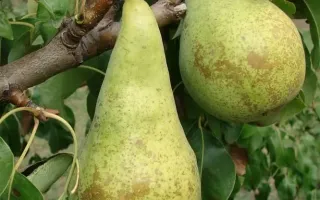
Fruits are large, relatively one-dimensional, rhomboid-pear-shaped, regular in form, fruit surface smooth, fruit color at harvest greenish-yellow with a diffuse blush, during storage — lemon-yellow with intense purplish blush. Skin dots are barely noticeable, small. Fruit skin is relatively thick, smooth, shiny, 'waxy' during storage. No rust. Fruit stalk is medium length, relatively thick, slightly curved, located in a shallow depression. Calyx is closed. Receptacle is small, wide, ribbed. Subcalyx tube is usually funnel-shaped. Ovarian cavity is long and narrow. Seed cavity is large. Number of seeds is low. They have medium size and light-brown color.
Fruit flesh is yellowish-white, tart-sweet taste with characteristic 'Kiffneroid' flavor, fairly juicy, medium firmness, fine-grained texture with granules present. Fruit has an attractive appearance (5 points), table quality (3.8 points).
Fruits contain dry matter — 12.5%, sugars — 10.0%, titratable acids — 0.13%, ascorbic acid — 1.9 mg/100g.
Early winter variety. Harvesting ripeness occurs at the end of September, consumer ripeness from October 15 to December 30. Vegetation ends at the end of October. Fruit drop before harvest is medium.
Fruits are transportable and high-quality. The variety is characterized as table; fruits can be used to make excellent jams and compotes.
Self-incompatible; best pollinators: Pass-Crassan, Bere Ardanpon.
Medium time to fruiting. Trees have medium yield. Yield per hectare is 340 centners, which is 200% compared to the regional variety (Kure). Fruit production is regular. According to M. M. Mursalov et al. (1999), in Dagestan on 'R3' pear, yield reached 543 centners per hectare.
Moderately resistant to extreme environmental conditions. It is relatively winter-hardy, as evidenced by the 1968/69 winter when temperatures reached -29.6°C; frost damage was rated 2 points. The variety is moderately drought-tolerant, not affected by scab, but susceptible to pests.
Advantages of the variety: high adaptability, resistance to scab, high fruit quality, good raw material for canned goods industry.
Disadvantages of the variety: sparse crown, which requires thickening through summer pruning in the early years of tree growth in the orchard.
Crop & resistance
Crop
Disease resistance
Specifications
| Type of Sort | |
|---|---|
| Catalog | Catalog → Pear |
Not yet комментариев. Be the first!
Alternatives
Pear saplings · similar varieties




See also
Often considered together with this variety



Recently viewed
Products you’ve viewed on this site
Reviews · 0